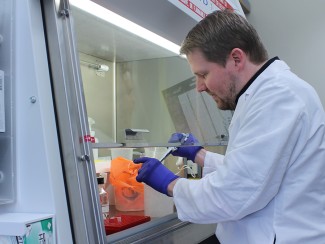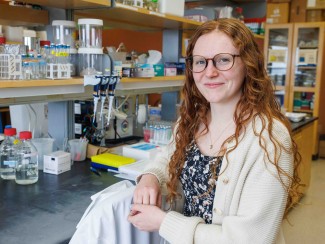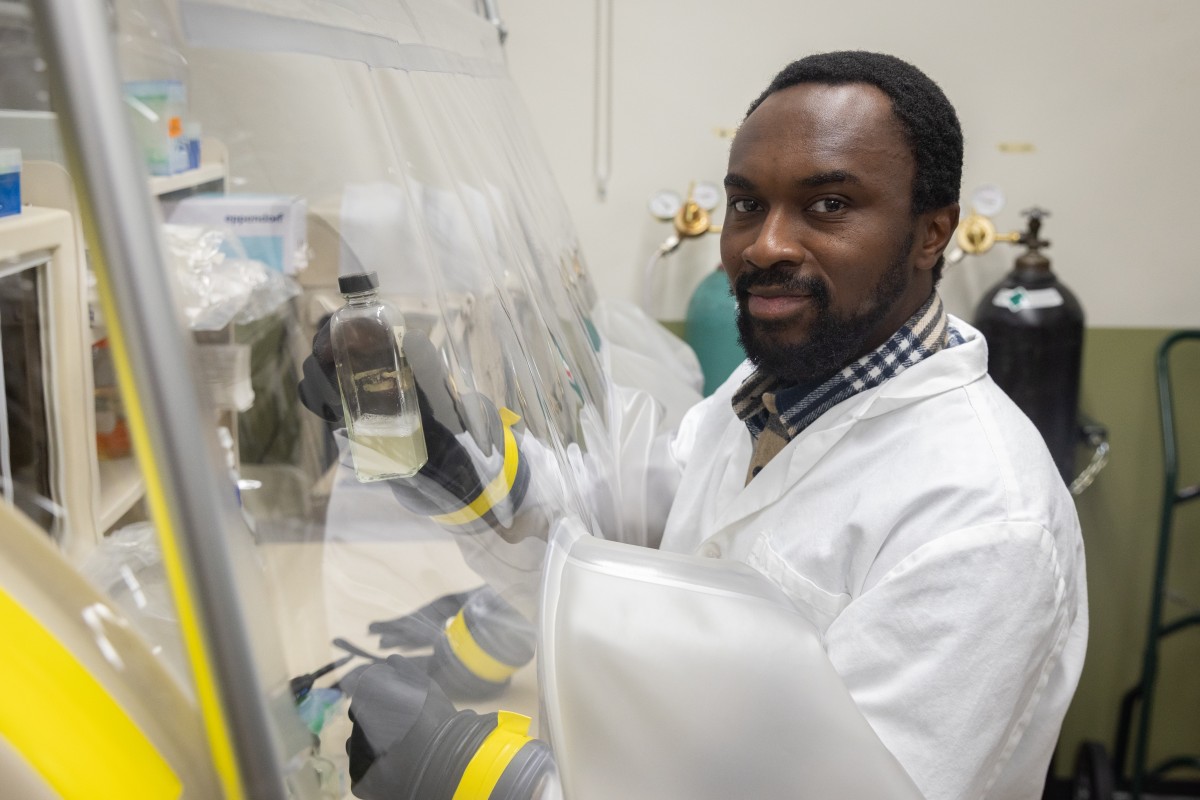
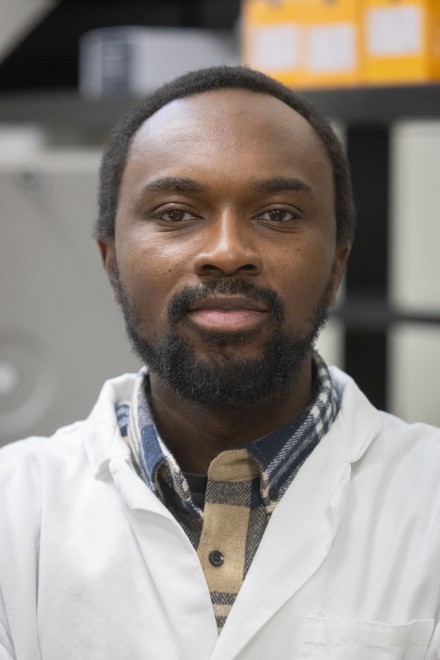
A research assistant in Victor Ujor’s lab, Eric Agyeman-Duah is a doctoral student in the food science program at UW Madison. He specializes in metabolic engineering and fermentation, particularly the conversion of waste into biofuels and biochemicals.
What do you do at the Wisconsin Energy Institute?
Currently the United States is trying to reduce carbon emissions so we are finding alternative means to produce energy and biochemicals. Until now most of the chemicals or fuels have been produced from fossil energy which releases a lot of carbon and contributes to a greenhouse effect. Some alternative feedstocks we’re using include whey permeates from the cheese industry, lignocellulosic biomass hydrolysate, and glycerol wastes. I've so far worked with glycerol, anaerobic digestate waste, lignocellulosic biomass hydrolysates, and also whey permeates from the cheese industry. My primary goal is to valorize these wastes into 1,2-propanediol and butanol.
You can run a car on cheese?
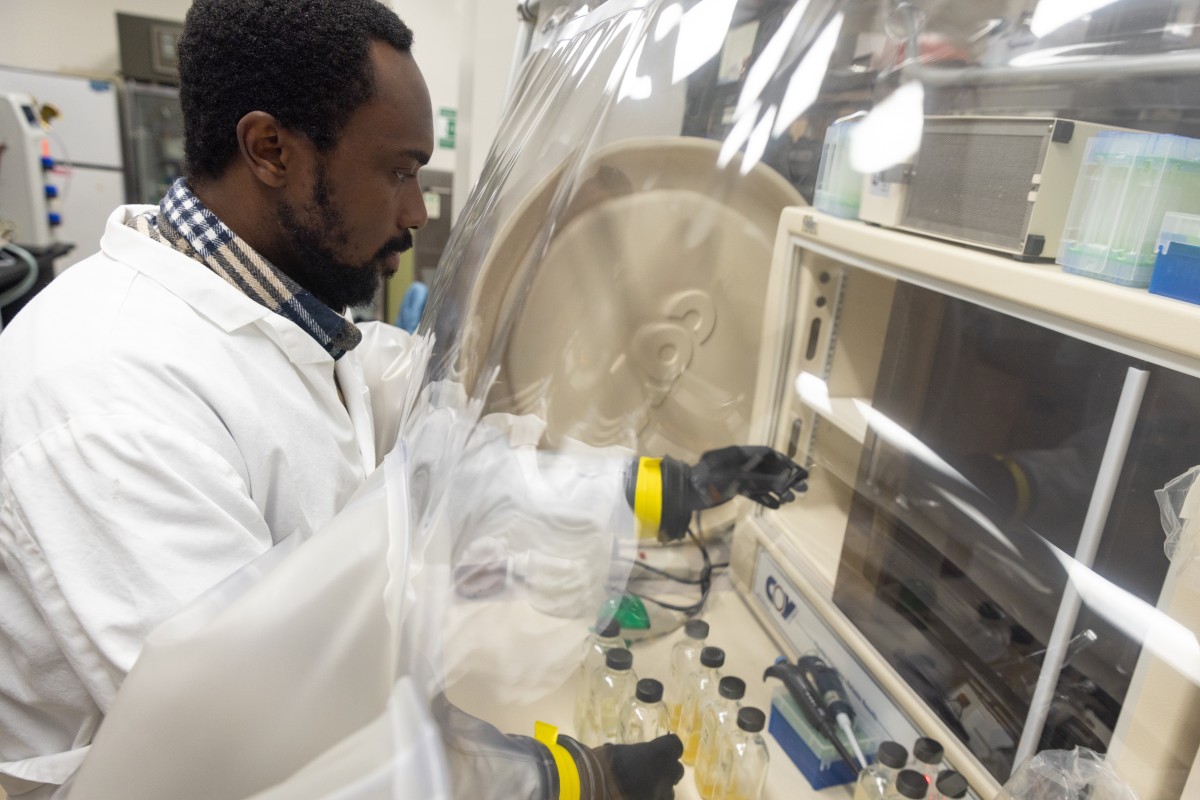
I'm currently working on it. Cheese whey permeate contains a lot of lactose and some other sugars. That's what we are trying to use to feed the microbes and then direct them to produce certain compounds that we are interested in. I've so far produced fumarate, 1,2-propanediol and butanol via bioprocess engineering. 1,2-Propanediol has pharmaceutical uses and can be used in aviation. It's very thermostable, so they use it in airplanes as de-icing or anti-icing agent to prevent ice build up during cold weather conditions. Butanol is also used as fuel. Just like we mix ethanol into gasoline, butanol can equally be used as gasoline blend or on its own.
What do you like about WEI?
I'm in my fifth semester now, and probably about to finish my studies. So far I really enjoy the facilities of WEI and the support they provide to us. I'm in the food science department, but I also analyze some of my samples here, and their support has been very helpful so far. My principal investigator is part of the WEI, and my work is in line with the biochemical-bioenergy interests of the WEI. Even though we are in food science, we do a lot of microbial engineering implementations.
What do you enjoy about your research?
Human beings, we need to evolve. We need to change. That’s why I'm interested in functional genomics, genes changes and the creation aspect of it. We’re trying to engineer new strains of microbes to produce something that they normally don't do, and that's something I'm really interested in. I also want to take on the challenge of global public health and global warming issues, and want to be part of the solution. I love challenges. I get bored easily, so I always want something challenging and microbial work is very tough. The more the challenges come in, the more agitated I get to chase after everything. It feels good when you get the result at the end, especially when you create a new organism that produces the desired product. It gives you more motivation to keep going.
What are you currently working on?
In my recent work, I have developed a new strain of Clostridium beijerinckii and used it to ferment whey permeate. Compared to the unengineered strain, I have successfully produced 1,2-propanediol and about twice the amount of butanol. I'm still investigating how to tweak it to produce more of these bioproducts to meet industrial scale and am also hoping to publish a paper by the end of the year.
What made you decide to pursue science as a career?
In high school, I used to watch forensic mystery series. They used to have a show where a crime would be committed, and then a forensic scientist would come and pick up samples. They said he was a biochemist, and after that I was very interested in biochemistry. I did my undergrad in Ghana in biochemistry, and then moved to Germany for molecular medicine, but I focused more on bioinformatics and high-throughput data analysis. When I finished I realized I was more interested in biotech than a medical route.
What are you interested in doing next?
I’m very interested in renewable energy and synthetic biology applications. My major goal is to develop synthetic biology tools useful for bioenergy production or treatment of diseases, because I have both medical and biotech backgrounds.
What advice would you have for somebody who wanted to do what you do?
It’s a lot of commitment, especially in the microbial field. It gets a bit challenging, and it's not straightforward. Sometimes it works, sometimes it doesn't work. So you have to be highly committed, be patient, read widely to get more knowledge and be ready to work at all times.
What do you do in your spare time?
I love music, especially rap music. I used to write lyrics for my friends in school, but I would never put myself in there. Two years ago, I went for a program where we couldn’t get a DJ to play music for us. I started learning how to mix songs on my phone and had experience with other DJs’ equipment. Now I can do everything with only a laptop. I have youtube and audiomack channels where I upload my music mixes. When I'm bored or my experiment doesn't go well, I just record some audio mixes, upload it online and I’m good. It helps with my research because it's a way of therapy for me. I don't put any frustration on anything or anyone when things are working in the lab. I just go back to listen, create, and then come back to the lab.
What do you think is the coolest thing about yourself?
I think it's my ability to adapt to situations. I'm much more an adaptable guy than someone who will try to put their preference or whatever on others. I try to make the best out of every opportunity, that's something I'm really good at. I'm not a complaining type of person so I try to make the best of what little I have.
Is there anything else you want people to know?
I believe bioenergy has a very promising future. The world is transitioning to renewable energy and this field of research deserves interest especially in the United States. It has a huge prospect to boost the bioeconomy in the future. About myself, I will say that I'm just a cool guy who is enjoying what life has to offer.