Study combined lab experiments and computational modeling to identify the best solvent system for a process that converts plant material into high-value chemicals
The Science
Plant fibers are a potential renewable source of fuels and chemicals traditionally derived from petroleum. Plant cell walls are made up of sugars bound together by lignin, a matrix of molecules (called a polymer) that provides structure. Microbes can ferment sugar into alcohols and the ring-shaped molecules in lignin into valuable chemicals. But the parts first need to be separated and broken down into smaller units, or monomers. This is especially hard because of lignin's strong chemical bonds and a tendency for unstable fragments to react, forming new molecules the microbes can't digest.
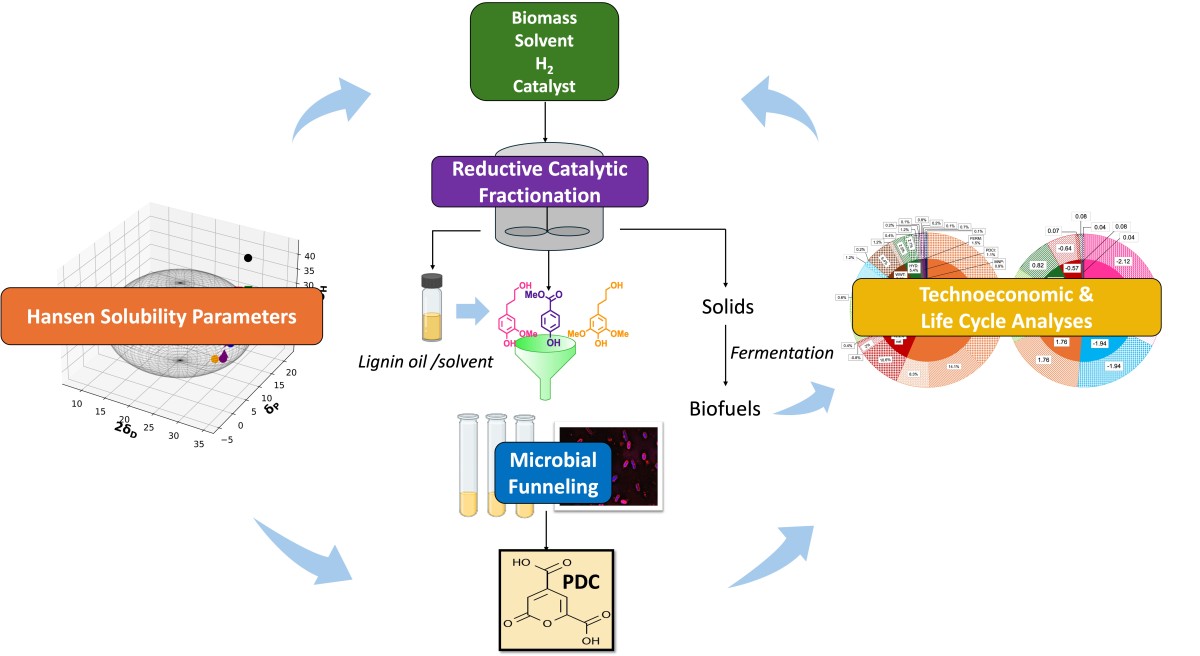
Reductive catalytic fractionation (RCF) is a technique for extracting lignin and splitting it into monomers using solvents under high temperature and pressure with a metal helper (catalyst) that speeds up chemical reactions. The type of solvent affects how much lignin is dissolved, the mix of molecules produced, reactor operating pressure, and compatibility with the microbes.
Methanol is commonly used because it is effective, but the high operating pressure required means the reactor needs thick walls, which cost more money and make the product more expensive. Mixtures of alcohol and water can improve process efficiency and reduce operating costs, but a wide array of solvents and mixtures makes it difficult to test them all using traditional lab experiments.
Building on previous work using RCF to deconstruct poplar, Great Lakes Bioenergy Research scientists evaluated six solvents in pure form and in varying mixtures with water and used the results to develop a computational model for solvent selection. The results showed a 50/50 mixture of methanol and water performed the best because it reduces reactor pressure and doesn't interfere with the microbes and lowers the break-even cost of the product by 24%.
The Impact
Non-food plants — including trees, grasses, and inedible parts of food crops — are a potential renewable source of fuels and chemicals traditionally made from petroleum, but advances are needed to lower the production costs. This research identified solvent systems that maximize product yields at lower pressure, which could reduce the selling price of the product. In addition, the modeling tools developed here could be used to speed up solvent selection for other systems without extensive physical experiments.
Summary
RCF is a two-step process that extracts lignin from cellulose and hemicellulose at high temperature and pressure in an organic solvent. Lignin adsorbs onto the heterogenous catalytic surface and is depolymerized through catalytic hydrogenolysis. In previous work, Great Lakes Bioenergy Research Center scientists developed an integrated approach to produce PDC (2-pyrone-4,6-dicarboxylic acid) from poplar biomass through chemical depolymerization into a mixture of phenolic compounds using hydrogenolysis followed by microbial funneling to PDC with an engineered strain of Novosphingobium aromaticivorans. Replacing serial lignin isolation and hydrogenolysis steps with RCF increased the monomer and PDC yields. Techno-economic analysis (TEA) indicated a minimum selling price of $18.39 per kg, a 29% reduction compared to previous results.
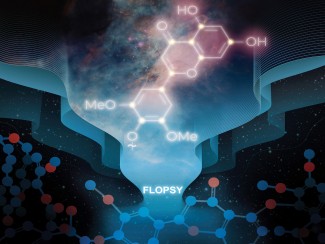
Here, scientists integrated RCF and microbial funneling experiments with computational modeling to assess predictors of phenolic monomer yields, TEA to assess the cost of an integrated poplar-to-PDC biorefinery, and life cycle assessment (LCA) to assess the carbon footprint. They investigated six solvents (methanol, ethanol, isopropanol, isobutanol, 1,4-dioxane, and ethylene glycol) and their aqueous mixtures of 5–50 vol% water, for a total of 30 systems. They developed a computational model to correlate experimentally-determined monomer and PDC yields with the Hansen solubility parameters of each solvent. They modeled operation of an integrated poplar-to-PDC biorefinery for 12 solvent systems (six pure solvents and 50% aqueous mixtures), providing comprehensive TEA and LCA insights into solvent selection. Analyses identified a 50 %vol methanol/water system as optimal because it reduces RCF reactor pressure and is compatible with microbial funneling by N. aromaticivorans. This system produced 63 g PDC per kg biomass from 85 g phenolic monomers per kg biomass at a reactor pressure of 48 bar (reduced 26% compared to previous work). The minimum selling price for the system is $13.98 per kg of purified PDC, a reduction of 24% compared to previous work.