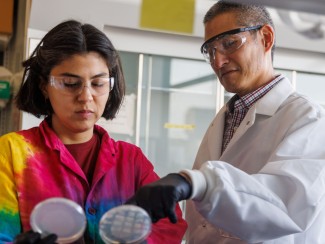
Solving puzzles at the molecular level
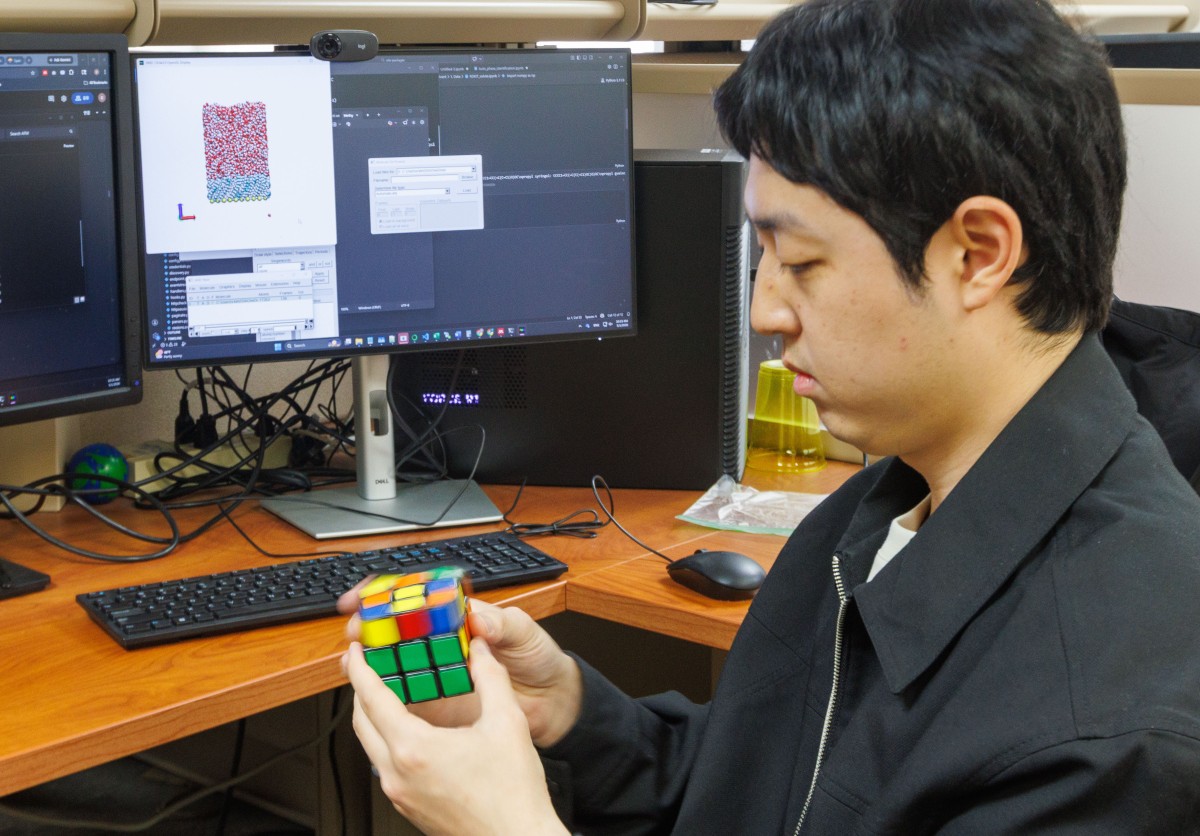
Changsu Kim is a third year PhD student in the Department of Chemical and Biological Engineering at UW–Madison. He specializes in molecular dynamic simulations and artificial intelligence (AI) and has worked with the Great Lakes Bioenergy Research Center to design models for selecting the best solvent mixtures for isolating lignin, a chemical-rich but hard to process part of plant cell walls.
GLBRC research aims to break down lignin into smaller units that microbes can turn into valuable products. How does your research contribute to that goal?
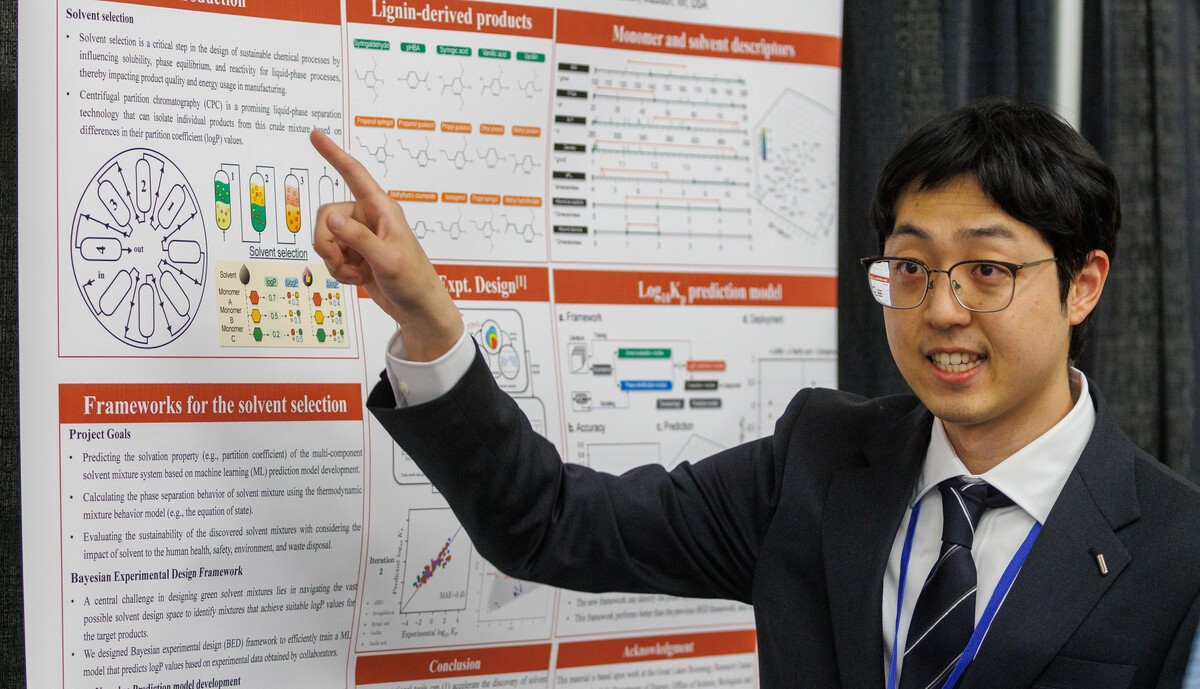
Separating those unique building blocks from a big complex of organic material is difficult. It’s similar to [crude] oil distillation. Many different varieties of chemicals are mixed together. In order to use them for microbial upgrading, you have to take them out from the whole mixture. I developed a software model using artificial intelligence to predict the properties of the solvent, which extract the specific chemical for this microbe consumption.
The difficulty is in the collective behavior of the solvents. If you use just one chemical solvent, it's already known, but if they're mixed together, their properties are totally different from the individuals. And, AI can help to interpret this mixture behavior.
How do you go about designing something that can make those predictions?
My model depends on a database. The database has a lot of fundamental properties of individual solvents. And then I collaborate with the experimental team. They can test out a few sets of experiments. They mix some random set of different solvents and then actually measure the solvent property. That can tell me what that set of solvents is good for. And then I can use this data set to train the model. Basically, I tried to predict the hydrophobicity [how much water is repelled when different solvents mix]. How hydrophobic a surface is depends on the environment’s temperature, pressure, and the component of the surface material. Pretty fun subject.
I didn't really see anyone doing science near me. Not just my extended family, but my whole village.... So, I’m always carrying self-doubt that I might not belong here.
Changsu Kim
What was your favorite part about this project?
I feel very lucky to be a part of a team that can contribute on a national level. The GLBRC is a really big program under the Department of Energy. I can more closely see how the national level research and development is envisaged. I have the feeling of being involved with a much bigger team. People are doing some crazy stuff that I never imagined. For example, one study I found interesting analyzed the microbial membrane transporter. Some lignin-derived compounds can be toxic to the cells. The study examined how membrane transporters export these toxic compounds to prevent their accumulation, which is essential for maintaining cell viability. That's something that is really important and something I never thought about. It is an amazing feeling that I am part of the group that came from a diverse background and we all run together to achieve the same goal.
What’s your academic background?
I studied chemical engineering in my bachelor and master’s programs at different universities in South Korea. I did process systems engineering, which is not really related to molecular dynamic simulations. But I have some experience with AI, and I also have some experience with process design – like designing a factory to manufacture a certain kind of chemical based on a given feedstock.
Was there a certain point in your life that you realized you wanted to do research?
I feel like I didn't really have a choice. I just like solving puzzles. Any other simple task always bored me, even school subjects. That's why I didn't really have good grades in high school: I’m always seeking the most difficult problems. When I think the problem is simple, my brain just kind of stops. The same for the research too. When the research is almost done, the mystery is kind of solved. My brain also stops. That's a huge bottleneck.
What other sorts of puzzles do you like?
Rubik's cubes. Back in high school, I did it within 17 seconds. I was young back then, so my hand was much faster. I also like Xiangqi (Chinese chess). But I accidentally met a Grandmaster and haven’t played since.
Wait, how do you accidentally meet a grand master?
I was at the mall, and there was a chess board and a grandma sitting there, an old lady. I thought, “I'm gonna teach her.” She was someone that my father knew, and I was a high school student. My father started to laugh as I sat at the table and started to play. Within about thirty seconds, I knew something was going on. I had already lost. As soon as she made her second or third move, I already knew. She was just so beyond me.
Aside from puzzles and research, what else do you do with your free time?
Well, I need to develop a new hobby. In South Korea I did a little archery. But ever since I came here, the first year of my PhD was very, very busy. A lot of coursework to follow, getting more adapted to the living environment. Then the PhD candidate exam. Now I feel like I need to make a new hobby. I want to do woodworking.
Why woodworking?
It's productive. I like the feeling of making something useful with my hands. I want to make an armchair. I really love real solid wood furniture.
Do you feel like there are any obstacles you've had to overcome to get where you are?
Just self doubt. I’m a first generation college student, and I was a first generation high school student, and I’m the first generation going to grad school too. I didn't really see anyone doing science near me. Not just my extended family, but my whole village. Everyone kind of seemed to be working in the industrial sector, like milling, sewing, those kinds of jobs. I liked engineering from the beginning, but I didn't know what to do in my life or how to get that career. I didn't even know the name of the career I should follow. So, I’m always carrying self-doubt that I might not belong here. Right now I’m working on my doctorate, and this is a job that nobody really can tell me how to do. Because I'm the one who is discovering problems and how to solve them.
What I want is just solving the mystery, finding the next puzzle. I have met a great mentor, and they sometimes push me to go in different directions. I have good momentum, so I'm just pushing myself in this direction.