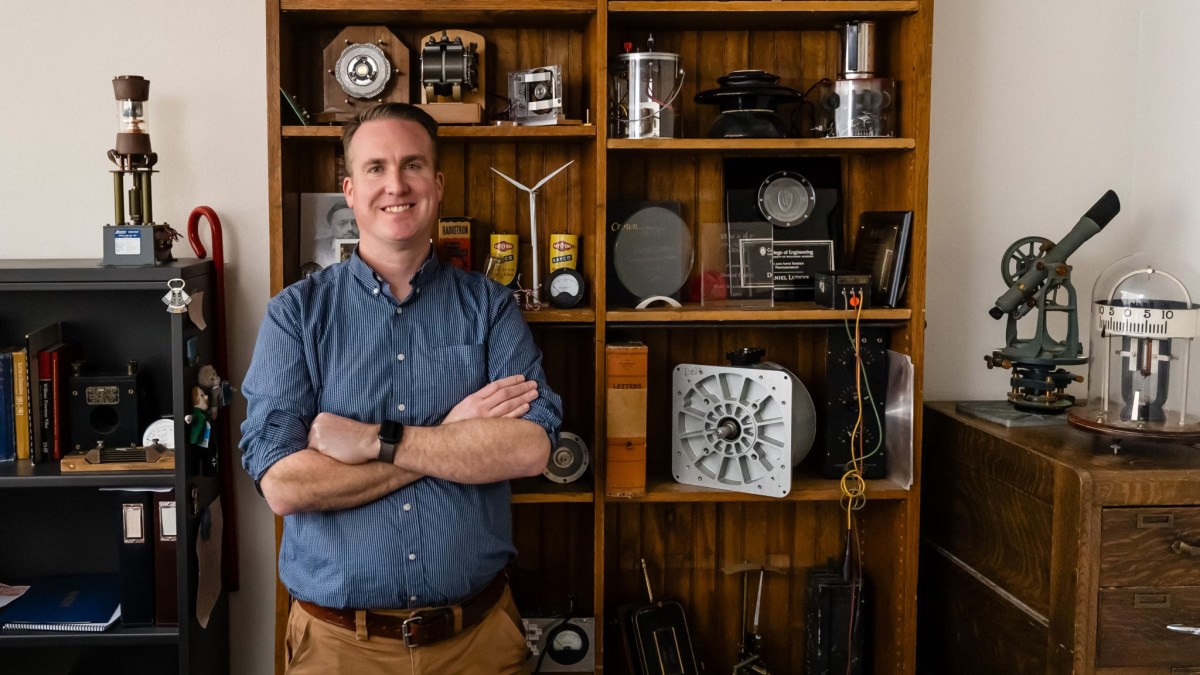
Wisconsin Energy Institute investigator Dan Ludois has been named a fellow of the National Academy of Inventors.
The organization announced the award Thursday, noting that fellows “are tackling the biggest and most pressing issues of our time” through their work on fields including quantum computing, artificial intelligence and regenerative medicine.
Ludois, the Jim and Anne Sorden Professor of electrical and computer engineering and the research and innovation director of the Wisconsin Electric Machines and Power Electronics Consortium (WEMPEC), is breaking new ground in electric motor technology.
Ludois’ work focuses primarily on integrating novel materials, designs and techniques to enhance and create electrical and electromechanical power conversion devices across many different scales, from massive power grids to industrial automation and vehicles.
Ludois is developing new classes of power converters that use less of the copper and steel that conventional electrical systems rely on so heavily. To do this, he focuses on innovations using wide bandgap semiconductors, dielectrics, and advanced manufacturing to enable capacitive coupling, or the use of electric fields to transfer energy instead of magnetic fields. Ludois was the first to show capacitive coupling can be used to charge electric vehicles and support industrial motors.
He’s also developed a converter that could allow us to efficiently harvest offshore ocean wave or wind energy, and has revived wound-field synchronous machines, an older type of motor that, upgraded with modern materials, is as powerful as conventional motors without the need for expensive rare-earth permanent magnets.
Work on electrostatic motors, however, has brought Ludois the most attention. Inspired by designs that date back to the era of Benjamin Franklin, these motors rely on coulomb force, or electric charge, to produce torque—instead of the magnetic fields used by conventional motors. This means electrostatic motors can do away with copper windings, steel and magnets, and be made of low-cost materials like plastic, aluminum and ceramics. They also reduce electricity costs and maintenance.
A spinoff company called C-Motive, co-founded by Ludois and based in Middleton, Wisconsin, is currently commercializing these electrostatic motors. In July 2025, the company, which employs 30 people, raised $13.5 million in investment capital. It now has pilot projects with Rockwell Automation and other companies, with hopes of scaling up to other industrial applications soon. As a professor, he also encourages and supports entrepreneurship among his graduate students, with members of his team going on to found the electric motor manufacturer H3X Technologies and grid management company Skylark Energy Solutions.
While the business is taking off, Ludois, who is C-Motive’s chief science officer, says he has no plans to abandon the laboratory.
“I like to consider myself balanced between a classical theorist and analyst and a basement tinkerer. You can still make a difference by getting your hands dirty in a lab,” he says. “In this era where it seems like computers can do anything, I’m one of those old-school holdouts who thinks you never know what you’re going to be able to do until you try. You can find out all the things that the models and computers never accounted for. For me, the biggest aspect is to be creative. Research is still a human enterprise, and I’m just thrilled to continue to be a part of that.”
Ludois was one of two UW–Madison faculty members, along with Gurindar (Guri) Sohi, included in the 185 inventors in the 2025 cohort, which collectively holds more than 5,300 U.S. patents.
Sohi is a professor in the Department of Computer Sciences, and his research has helped shape how modern microprocessors work. His work on microprocessors has helped improve the performance of processor chips, supporting the speed and reliability of modern devices like smartphones and laptop computers.
NAI fellowships are considered the highest professional distinction awarded solely to inventors, according to the organization. With the addition of Ludois and Sohi, UW–Madison now has 21 NAI fellows.