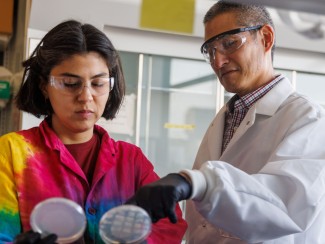
In which your host asks Wisconsin Energy Institute researchers “what do people study here?” Spoiler alert: It includes chemistry, photosynthesis, and cellular respiration.
Welcome to Energy 101, the podcast where Wisconsin Energy Institute communications intern Nalina Cherr brings experts questions both nebulous and microscopic about energy and leaves with more than she came with.
Episode 4 show notes
By the end of this episode I hope you’ve learned something about these things:
- Biofuel is produced through fermentation (cellular respiration) or breaking down carbon structures formed by photosynthesis. All these things work because of chemistry.
- It’s all full circle!!!
- A brief history of biofuel policy.
- There are other types of biofuel (e.g. isobutanol) that can also be set on fire.
- Ethanol is relatively easy to make, but there are challenges:
- Yeasts are picky eaters.
- Plants store carbon in lots of forms that microbes can’t naturally digest, like lignin.
- People at GLBRC study ways to make alcohol and other products from these lignocellulosic polymers.
- Biofuel is cool!
Fuel for future episodes
- What might be other challenges in producing biofuels and products or making them economically competitive with other energy options?
- What kind of plants are ideal for making biofuel?
- Can I make biofuel in my kitchen?
Sources and further reading
- Ong, R.G., et al. Inhibition of microbial biofuel production in drought-stressed switchgrass hydrolysate. Biotechnology for Biofuels 9, 237+ (2016). [DOI:10.1186/s13068-016-0657-0]
- VanWallendael, A., et al., Switchgrass Steroidal Saponins Reduce Fungal Disease but Decrease Yeast Fermentation Yield. GCB Bioenergy, 18, e70097. (2026). [DOI:10.1111/gcbb.70097]
- Basyal, B., et al., Developmentally-specific physiological and metabolic responses support drought resilience in switchgrass and constrains biofuel yield. Journal of Experimental Botany, eraf533. (2025). [DOI:10.1093/jxb/eraf533]
- Gleizer, S., et al. Conversion of Escherichia coli to Generate All Biomass Carbon from CO2. Cell, 179, 1255-1263.e12. (2019). [DOI:10.1016/j.cell.2019.11.009]
Guests

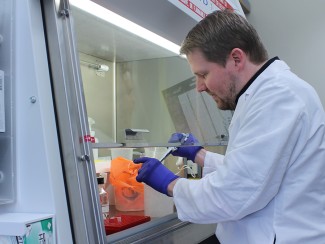
Kyle Probst, Experimental Fermentation Lab leader at the Great Lakes Bioenergy Research Center; (Google scholar profile)
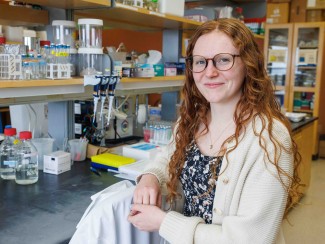
Sam Davison, PhD researcher, UW–Madison
Credits
Nalina Cherr, writer/editor/host
Theme song written and performed by Graham Goodman (Listen on Spotify; follow on Instagram); Other music: “Freedom Bike” by Dagored (FreeToUse); “Alternative Direction - Rebel Rock Energy” by Sonican (Pixabay)
Transcript
Unidentified female speaker 0:03
Energy, isn't that like just what I have after I drink my morning coffee?
Energy is energy is the ability to do work. It's like the way things move. I'm running out of energy.
Unidentified male speaker 0:20
Energy is a term used to express the amount of work stored in a body.
Nalina Cherr 0:44
Welcome to Energy 101, the podcast that breaks down complex lignocellulosic science into delicious sugary audio segments that you can digest into your own personal nerd fuel. I'm your host Nalina Cherr, a communications intern at the Wisconsin Energy Institute and undergraduate at the University of Wisconsin Madison. This is a four-part season. We've talked about chemistry. We've talked about photosynthesis and cellular respiration. Welcome to part four: Fuel Up, the stunning conclusion where I reveal that all of the science that I'm learning about in school and talking about with researchers is really just so I can understand how booze gets made. Sorry, biofuel. Last episode, we were talking to Kyle Probst about fermentation. Fermentation is a process that breaks sugars and carbon structures into products like ethanol. Ethanol and the microbes that make it is one of the main areas of study of the Wisconsin Energy Institute because, in addition to being alcohol, ethanol also happens to burn really well in cars. And the PSA for any people who are going, whoa, they're the same molecule. Does that mean I can drink biofuel? No, no, you cannot. Ethanol that is made for industrial reasons like cars or labs, usually has what is called a denaturant in them in it, which is something poisonous. For example, methanol, which will make you go blind or also kill you. This episode, we're actually continuing our conversation with cow probes, but we're going to take a closer look at what he does here. Stepping away from cellular respiration, but not actually because it's all related. Jumping into biofuel stuff. What do you do here at the WEI?
Kyle Probst 2:40
I'm the leader of the Experimental Fermentation Lab, and we are a core facility within the Great Lakes Bioenergy Research Center. We offer our services, products, and resources to support and collaborate with the different teams within the the GLBRC at the Great Lakes Bioenergy Research Center.
Nalina Cherr 2:56
Quick note: I don't think it's come up yet, but Kyle here is talking about the Great Lakes Bioenergy Research Center, or GLBRC, that has a research organization that has labs on a few different campuses, including Michigan State. But the labs here are a part of WEI.
Kyle Probst 3:10
We primarily support a lot of the fermentation research.
Nalina Cherr 3:14
So you're sort of like a lab for other labs.
Kyle Probst 3:18
Correct. Yeah, a lot of it's around making alcohols. So we have certain organisms that we use to ferment what we call lignocellulistic hydrolosates and alcohols.
Nalina Cherr 3:31
Whoa! Hold on. Okay, lignocellulosic hydraulysate. That's a mouthful. Let's try and break it down a little bit. We talked about lignin back in episode two, photosynthesis. It's the woody parts of plants. Cellulosic lose-you might know from lactose or glucose. Ose is a sugar suffix, so cellulosic. Cellulose is cell sugar, and then hydrolysate. Sometimes you're going to hear hydrolysate, and sometimes you're going to hear hydrolysate. It's the same thing, but hydro: water and lysate. Lyse. I can't think of a good word in the English language that has that root, but lyse is kind of like an explosion. So, like when a cell lyses, it it breaks apart. It explodes. When we say so, when we say hydrolysate, we mean we broke something up using chemistry and water, so that makes all together lignocellulosic hydrolysate, woody cell sugar bits of plant cells that we broke apart using chemistry and water.
Kyle Probst 4:34
So at the GLBRC, the focus is on trying to make second generation biofuels. Second generation biofuels, you're looking at biomass as the input, as opposed to first generation. First generation biofuels are made from food crops. They're a lot easier to ferment because the sugars are readily available, but they do compete with food, and they do require a lot of land and water. Whereas second-generation biofuels use non-food biomass, so things like agricultural residues, grasses, and wood, and they don't compete with the food supply. But the challenge is they're harder to break down, and these feed stocks, while they're rich in cellulose, which if you break that down, that is glucose. There's a lot of other things that are in there, like the lignin. The lignin is what gives plants their like structure.
Nalina Cherr 5:25
Just like how you chew your food before sending it to get digested in the stomach, microbes find it easier to digest biomass that's already been blown up into smaller building blocks like sugars and carbs. But sometimes when you break apart biomass, you also end up with little odds and ends that are toxic to microbes like acids and amides and saponins and whatnot.
Kyle Probst 5:45
So, so that's one of the main areas within our lab. We help support. So we have, you know, capacity to do bio reactor scale fermentations in the lab. We also do make hydrolosates in our lab too, so we can convert biomass into the hydrolosate. Hydrolosate is something that's been broken down into utilizable components. So for the biomass, we're breaking it down into sugars.
Nalina Cherr 6:11
Gotcha.
Kyle Probst 6:11
There's also some some other things that that come along with it. If you were to see this process play out, you'd be surprised because the biomass, when you mix it with water, it doesn't mix, right? We add enzymes to it, and we have the proper conditions, and it actually takes the biomass and liquefies it.
Nalina Cherr 6:28
So it's kind of digesting it in the water.
Kyle Probst 6:31
That's right. It's digesting it. Guess where the enzymes come from that we use?
Nalina Cherr 6:34
Microbes.
Kyle Probst 6:35
Yeah, fermentation.
Nalina Cherr 6:38
It's all full circle.
Kyle Probst 6:39
Yeah, right. It is like a full circle. So yeah, and and then the other thing that we do too, and this is kind of a cool part of what we offer as a service. And I'd say that this is the thing we do on a routine basis. We deconstruct and ferment small amounts of biomass into into biofuels like ethanol. So it's like higher throughput, so we can process lots of biomass and ferment it, and see how different things from the biomass can affect fermentation. So we can look at like different genotypes, like if there's been a biomass that's been engineered, we can look at different agronomic practices, or even the impact of growing season. And there was actually one thing that came out of this. This is before my time, but they found that I think it was switchgrass when it was grown under drought. It had a big impact on fermentation.
Nalina Cherr 7:31
Kyle here is talking about a paper from 2016 called "Inhibition of Microbial Biofuel Production in Drought-Stressed Switchgrass Hydrolysate." Try saying that five times fast, which I will link to in the show notes for anyone who's curious. And just to summarize it, this research team used microbes to break down some different switchgrasses, and what they found is that switchgrass grown in drought was storing more sugars that, when exploded into hydrolysates or smaller bits using water, actually turned into toxic substances that would kill microbes during fermentation.
Kyle Probst 8:03
When you're trying to ferment a hydrolosate that has saponins in it, it can cause like no fermentation. Drought causes really poor fermentation performance of what's causing that in the area. You know they've been able to figure that out. Now they're trying to find ways. You know this is all active research going on. Trying to find ways. Can we figure out how to engineer the plants, or have you know something in place where we could minimize that
Nalina Cherr 8:25
right, right?
Kyle Probst 8:26
Minimize the the impact of saponins.
Nalina Cherr 8:29
How can research at the WI inform industry and impact biomanufacturing?
Kyle Probst 8:34
Yeah, I mean I think the one thing that we're doing here is you know helping the industry de-risk new technologies, right? We're the ones who are kind of at the forefront and can help answer questions like which feedstocks are the most efficient, how do we engineer microbes that work at an industrial scale, and and how do we make the economies work? We partner with companies, help work closely with them, share data, optimize processes, try and scale up ideas from the bench to commercial levels. I'd say it's a two-way street. We've benefited from you know real-world constraints that need to be solved, but the industry benefits from kind of the academic rigor that we do here.
Nalina Cherr 9:15
What do you see in the future of biofuel industry? Are there any recent interesting advancements or any like large obstacles that you're seeing right now that you think are going to get overcome, or like are the focus of research right now?
Kyle Probst 9:30
I'm an optimist, so I think the the future is promising, but I don't think it's going to be an easy one, right? So I think on one hand we have a lot of advancements in metabolic engineering, synthetic biology-I mean, you know, artificial intelligence, right? I mean, those are all things that can help us understand biology better to to be able to use it to our advantage, right? Biotechnology. I mean, there are some microbes that can now convert CO2 directly. Fuels and chemicals. That's that would be like a fourth generation biofuel, right? Like you're basically cutting out the plants from that.
Nalina Cherr 10:07
You might be wondering, and by you, I do mean my boss Chris Hubbuch, who is listening to this. Hey, if we can just feed microbes carbon dioxide, why are we bothering with plants? Well, as with many genetically engineered microbes, it's a work in progress. One research team at the Wiseman Institute managed to make a strain of E. coli that can eat CO2 but there is a caveat: it produces more CO2 than it eats. For every step forward, another step back. And again, I will link that paper in the show notes.
Kyle Probst 10:37
And there's more knowledge about how to process feedstocks better than ever, but you know there's still a lot of challenges, right? Especially around the cost, policy, and infrastructure. I mean, we're deeply entrenched with fossil fuels, so I think for biofuels to be successful, there needs to be better incentives and support to scale.
Nalina Cherr 10:56
Yeah,
Kyle Probst 10:57
I think that the future is is pretty bright for biofuels, and I'd say even even more in general, I think that the future is very bright for a bio-based economy. You know, I think that bio-based solutions will currently do play a role, and they're going to continue to play a role in transportation fuels, aviation, sustainable chemicals in the coming decade. And I'd also say one of the other benefits of a bioeconomy is its capacity to withstand, adapt to, and recover from disruptions, things like climate change, supply shocks, market volatility. So I think the the key point here is that you know a bio economy really will help be something that gives us resilience that bio based, you know, the bio-based solutions will certainly be able to offer, helping us diversify how we produce fuels, chemicals, foods, medicines.
Nalina Cherr 11:49
Now that we understand some of the work being done at the Wisconsin Energy Institute, I actually want to step back and talk a little bit about ethanol in a national context. Well, me and Sam Davison. That after the break.
Unidentified male speaker 12:05
You've heard of March Madness. Now get ready for Microbe Madness. We're down to the final pair. At one end of the ring, we have Saccharomyces cerevisiae, aka brewer's yeast. This single-celled fungi is single-minded. She just can't get enough sugar. After more than 5,000 years of coaching, she's ready to take on the champion of pulque and African palm wine, Zymomonas mobilis. This little bacteria's tiny genome makes him fast and flexible-a mean, keen fermenting machine. His diet is limited to glucose, fructose, and sucrose. Can it keep up with the hungry Saccharomyces cerevisiae? Find out tonight on The Fermenter, 9 p.m. Central Time on GLBRC News.
Nalina Cherr 12:57
We're back, and with us is Sam Davison, a PhD student who works upstairs. Sam actually dropped in way back last year to talk about starting a podcast, and then it turned out I was already here working on it. So now he's here to help me with mine. Kyle just told us about some of the work done here at the Wisconsin Energy Institute slash Great Lakes Bioenergy Research Center, but as he pointed out, the science of biofuel is tightly bound to the politics of it. So Sam's here to give us a little bit of a history lesson.
Sam Davison 13:26
My name is Samuel Aaron Davison. I work on the fourth floor of the Wisconsin Energy Institute under Dr. Chris Hittinger and Trey Sato.
Nalina Cherr 13:34
So the first combustion engine was invented in 1826, but ethanol didn't gain popularity until the 1970s. Can you tell me a little bit about why?
Sam Davison 13:44
During the Civil War, the Union, because they were burning through so much many resources, actually had to put a giant tax on alcohol that reached $2 per proof gallon. That would be like me spending $40 per gallon to fill my car.
Nalina Cherr 13:59
That's really expensive.
Sam Davison 14:00
You can imagine if people are having to like try to do some research on using ethanol as a fuel source, but now each barrel costs like 60 or 20 bucks in that olden time days money. You can expect that like no one really wants to research that field of research. With the rise of oil extraction and refinement improving over the 1800s, oil took off as an energy source that contains significantly more energy than ethanol when burned. Petroleum is very powerful fuel; it's more has more energy in it than like ethanol. So, if I were to burn the same amount of ethanol and petroleum, I'd get more kick out of the petroleum than I would get out of ethanol. The economic law of supply and demand made oil the logical liquid fuel that would be used to modern day.
Nalina Cherr 14:44
Why did ethanol fuels become popular again later on?
Sam Davison 14:47
You can thank geopolitics for that. In 1970s, there was actually an embargo on oil and petroleum from the Middle East, which was a large supplier of petroleum back in the day.
Nalina Cherr 14:57
OPEC, O P E C, or the Organization. Of petroleum exporting companies is an international organization that unites surprise petroleum producing countries. In 1973, during what is sometimes called the Yom Kippur War, violence between Arab states and the State of Israel broke out. As happens, when the U.S. backed Israeli troops, Arab countries and OPEC cut America off from their suppliers, quadrupling the price of petroleum oil.
Sam Davison 15:25
Energy companies and many Western countries, including the United States and Brazil, needed a quick little term to not have both an energy and economic crisis because of this invested architecture and infrastructure. That is where people went back and relearned the roots of the modern engine, and they found ethanol. More specifically, using domestic resources like corn to make the first ethanol petroleum blends to dilute the domestic fuel supply and allow barrels of oil to go farther. This was being called gasohol at the time, at least by the Carter administration.
Nalina Cherr 15:58
So why was ethanol, aside from from having previously been used, what made it seem so appealing, and how did it lead to more self-reliance?
Sam Davison 16:07
Yeah, it's because of corn. It always comes back. The United States has a lot of corn, a whole lot of corn, more corn than we know what to do with, at least at the time. The U.S. government and energy companies landed on the idea to use some of that whole lot of corn to make 10% ethanol blends. Of course, petroleum is limited resource, and so we have ethanol here because we can resupply it. We can grow crops from we can grow crops that we can use that crop to actually make that that ethanol. Right? We can't do that with petroleum unless you're willing to pressure cook a bunch of dinosaurs, for example, for millions of years, right? And we don't have that time.
Nalina Cherr 16:46
You don't have that time.
Sam Davison 16:47
I I
Nalina Cherr 16:47
have a pressure cooker full of dinosaurs in my basement.
Sam Davison 16:50
What dinosaur chicken nuggets? I don't think that counts, but sure.
Nalina Cherr 16:54
There'll be there'll be there'll be petroleum one day if I wait long enough.
Sam Davison 16:58
Yeah, that's how it works.
Nalina Cherr 16:59
Ethanol seems like a pretty good choice in so far as it's more sustainable than petroleum. Instead of pulling it out of the ground, we're pulling it out of plants. Why isn't ethanol the only energy source that we use?
Sam Davison 17:13
So, like I talked about, like how it's greener, but like that actually can be really relative depending on how you look at things, right? So the main crop that we get from this ethanol is corn, right? And we can only really use the endosperm of corn, which, for those that don't know, is really just like this inside the nice, good part you eat when eating corn on the cob, right?
Nalina Cherr 17:32
Okay, so just like it's easier for you to eat corn, it's also easier for a microbe to eat that part of the corn and turn it into juice.
Sam Davison 17:40
Yeah, so that's the idea. It's like for now we can only really use the endosperm to fuel yeast to make ethanol that we can then use for biofuel, right? But the issue is we can't use the stalk, we can't use the husk, and that's because it's more complex. It would be like me giving you a giant hay bale of wheat and like claiming that's bread -- enjoy! Right? You can't eat that, so we have to process that, and so like that's where our lab goes into, especially the experimental fermentation lab that I work and Jason with, where they find ways to cook that product so that that we can feed our yeast, and so they can make more ethanol.
Nalina Cherr 18:16
Okay, I have edited this interview a little bit for clarity, but somewhere in our conversation, Sam and I decided on the metaphor that breaking down corn into hydrolysates is like milling wheat into flour, and then the microbes eat it and turn it into ethanol, like bakers turn wheat into bread that you can explode in cars. What specific problems are scientists working on to make ethanol production more efficient and more feasible at an economically feasible scale.
Sam Davison 18:43
Yeah, so I work in yeast lab, right? And so part of that is hydrolosate. Although we cook it so that it becomes flour, so the yeast can make their bread from from ethanol, and they can eat the flour. They there's toxic things in there, right? Because it's made from plants, and plants have things that protect themselves from wild yeast, for example, and so understanding what those things are and how they hurt our yeast, and how we can engineer our yeast to no longer be hurt by those those things can make them eat that hydrolysate more readily and be able to make more bread. Right. Another way is finding new ways to cook, cook the the plant matter,
Nalina Cherr 19:23
or to grind it into flour.
Sam Davison 19:25
Grind it into flour, exactly. And so doing that is also a way in like certain temperatures, certain chemicals to use. And then finally, going even farther back, right? I mentioned how we can only really use the endosperm. Finding how to how to cook the husk versus using the stalk of the plant would help. Even further back, maybe we can deviate from just not just corn from other plants. Right, corn is used for food, and so many people can would make an argument that like, oh, this corn could be going to feeding hungry families in America, especially with nowadays with grocery prices going up. Right, it's. Important that that people find ways to get cheap food. So instead of this corn being used for biofuel, it should be going to the people. And so, good question is: What if we could use other things? What if we just use your lawn clippings? What if we could just use the raked up leaves or the mowed off material that on the side of the road?
Nalina Cherr 20:16
Right, because all of those things are essentially made out of just carbon that's been pulled out of the air. Exactly, plants are just pulling out carbon and and making structures.
Sam Davison 20:25
Exactly, it's like
Nalina Cherr 20:26
you can break them down
Sam Davison 20:27
to keep with our wheat analogy, right? It's like using barley instead of wheat, or using rice to make our breads,
Nalina Cherr 20:33
or millet, sorghum.
Sam Davison 20:34
Yeah, there's many in quote wheats out there that we can go and utilize, but the problem is we have to figure out how to like churn it and make sure that our organisms can eat it.
Nalina Cherr 20:45
So, how does your work fit into this?
Sam Davison 20:48
I work on next generation biofuels. I don't work with ethanol. I work with something called isobutanol, which is basically just ethanol with two extra carbons to it. So, instead of having two carbons total, we have four carbons. If you were to burn one liter of ethanol and one liter of isobutanol, you would get more kick out of your isobutanol. Not to mention, it is more engine friendly because it absorbs less water and air, which means that the fuel remains pure for longer. And isobutanol can actually be utilized as a possible precursor for jet fuel,
Nalina Cherr 21:19
like for planes.
Sam Davison 21:20
Yeah. So chemists that are much more smarter than I am realize that they can use isobutanol to synthesize jet fuel, often called sustainable aviation fuel or SAFs. Now, these jet fuels can be made from ethanol, but chemistry is much more expensive to generate using ethanol. So instead, using the cheaper chemistry, they can use isobutanol to make those SAFs. But the problem is, yeast really don't like it. They can't hold that liquor. So yeast has, as we have known, has grown with civilization, as we cultivated it to make our breads, to make our wines, to make our whiskeys and and beers.
Nalina Cherr 22:03
So they're familiar with ethanol, which is also a waste product that can kill them. But they're more familiar with ethanol than isobutanol?
Sam Davison 22:10
They're more resistant to it. So the question is, why is it that there's a tenfold decrease in tolerance to isobutanol than ethanol, right? And that's my work because if we can figure out that and we can make as much isop as we can ethanol, we don't have to just use isophanol for cars. We can even use it for jet engines.
Nalina Cherr 22:34
So, in like the grand scheme of of our metaphor, if we're talking about plant sources as like raw wheat, and then the hydrolosates in the middle as flour, and then ethanol at the end as bread. You're like making like an artisanal sourdough.
Sam Davison 22:52
Yeah, I'm not. Yeah, I'm basically making a very very nice high class sourdough, basically with like garlic and butter
Nalina Cherr 23:01
and two extra carbon groups.
Sam Davison 23:02
And two extra carbon groups, right?
Nalina Cherr 23:04
Are we going to see isobutanol-based fuels in the future?
Sam Davison 23:07
Not any time soon, unfortunately. There are still some snags, some that I run into daily when I work in the lab, in the production of isobutanol that are holding back production, meeting the energy demands of the world. And as you can imagine, that demand is pretty large. Until we fix those issues, isobutanol will have to wait for its turn to take the sage as a as the main energy source of the world.
Nalina Cherr 23:31
Well, thank you so much for talking to me.
Sam Davison 23:32
Oh, thank you. It was pleasure.
Nalina Cherr 23:37
Thank you so much for listening to Energy 101. This season is a four-part series. You just heard episode four, fuel up. If listening to this episode got you fueled up to learn more about energy, I hope you'll tune in next season where I'll ask more researchers what fuels them. I'm already hard at work taking radio training lessons and stacking up interviews. You can catch wind of when those episodes are coming up by subscribing to this podcast on Spotify and by following us on Instagram at UW Energy Institute. Again, that's at UW Energy Institute for updates on this podcast and all the other wonderful UW Energy Institute programming. This episode's special guests were Sam Davison and Kyle Probst, with bonus audio clips from Kira Gorilla, Kieran Corey, Leon, and Odin Cherr, Aisha Goodman, Hoofer of the Sailing Club, and Afton Lemire. This episode was written and edited by your host Nalina Cherr with advice from Chris Hubbuch. Our theme song is written by Graham Goodman, who can be found on Instagram or Spotify under the handle Authentic Graham. You also heard Freedom Bike by Dagored and Alternative Direction - Rebel Rock Energy by Sonican. Special thanks to Dexter Patterson, the first person who wasn't my parents to tell me I'm funny when I try to be, to every person in my life who put up with my shoving a microphone in their face, and to you, whoever you are, whoever is taking the time to listen all the way to the end of the credits. I made. So you could listen to it. You are single-handedly validating my existence. And hey, I want to know who you are. I'll be sending out a few polls via Instagram in the next few weeks, hoping to get a sense of what you, dear listener, want more of, want less of, wish I would please include. So, yeah, keep your eyes peeled for that, or contact our team directly via Instagram or Semaphore to share your comments, critiques, or politely worded suggestions.
This episode was made possible in part by listeners like you. Thank you.
Transcribed by https://otter.ai