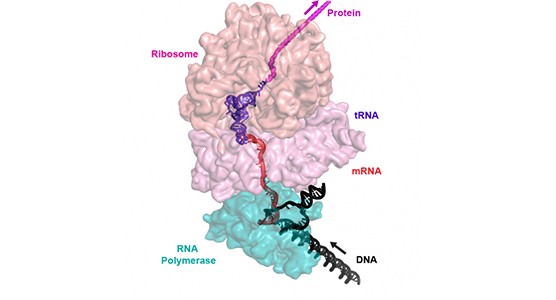
There are many processes that take place in cells that are essential for life. Two of these, transcription and translation, allow the genetic information stored in DNA to be deciphered into the proteins that form all living things, from bacteria to humans to plants.
Scientists have known for half a century that these two processes are coupled in bacteria, but only now have they finally had a look at the structure that makes this possible. In a paper published in Science today [April 13], biochemists from the University of Wisconsin–Madison and the Max Planck Institute (MPI) for Biophysical Chemistry in Germany have revealed the defined architecture of what is called the “expressome.”
The researchers say this work using the model bacteria E. coli could open numerous doors for research into how bacteria impact human health, including a better basic understanding of gene regulation and possible development of new antibiotics.
“The existence of this complex in bacteria has been postulated based on evidence but nobody had ever documented that it exists,” explains Robert Landick, a professor in the Department of Biochemistry at UW–Madison and author on the study. “It’s the first demonstration that you can form one large super-cellular machine out of these two already pretty complicated machines.”
Related News