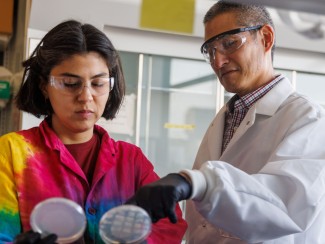
Just breathe. Yes, you. Wow, you’re doing science. Student farmer Ella DeRosier asks our host what happens to the sugars we eat and Morty the Mitochondrion (UW–Madison BioCore Coordinator Daniel Parrell) talks about his job in the big cell, and our host talks about ATP (again). Then we take away the oxygen and see what kind of cool stuff we can make.
Welcome to Energy 101, the podcast where Wisconsin Energy Institute communications intern Nalina Cherr brings experts questions both nebulous and microscopic about energy and leaves with more than she came with.
Episode 3: show notes
By the end of this episode I hope you’ve learned something about these things:
- Mitochondria are the powerhouse of the cell!
- They are genetically independent of people and are very efficient at making ATP.
- Chloroplasts and mitochondria both produce ATP using an ATP synthase, but mitochondria are more efficient at it.
- Mitochondria can only make ATP in the presence of oxygen because it’s very electronegative and can pull atoms downhill.
- Without oxygen, bacteria (and yeast, and sometimes people) keep breaking down sugars (glycolysis).
- This process is called fermentation and produces lactic acid (yogurt, muscle burn) and ethanol (alcohol and fuel).
- Fermentation has been used throughout history to preserve food and make drinking water safe.
- It’s also used in industry to produce biofuels and chemicals, including vaccine ingredients and cleaning supplies.
Fuel for future episodes
- Why are carbon structures like ethanol sources of energy for cars as well as people?
- What are the similarities between combustion and cellular respiration?
- How cool is it that my muscles and my sourdough make the same acid??????
Sources and further reading
- Becker’s World of the Cell 10th edition by Jeff Hardin and James P. Lodolce (This is the textbook from my biology class. It was referenced for the explanation of myosin as well as ATP and is a book I’ve spent a lot of time reading for academic reasons and therefore doubtless spread insidious seeds of learning.)
- Mitochondrial Glycolysis in a Major Lineage of Eukaryotes by Río Bártulos, C., et al., Genome Biology and Evolution, 10, 2310–2325. (2018). [DOI:10.1093/gbe/evy164]
- Molecular Biology of the Cell 4th edition, Chapter 14: Energy Conversion: Mitochondria and Chloroplasts by Alberts B, Johnson A, Lewis J, et al., The National Library of Medicine
Guests
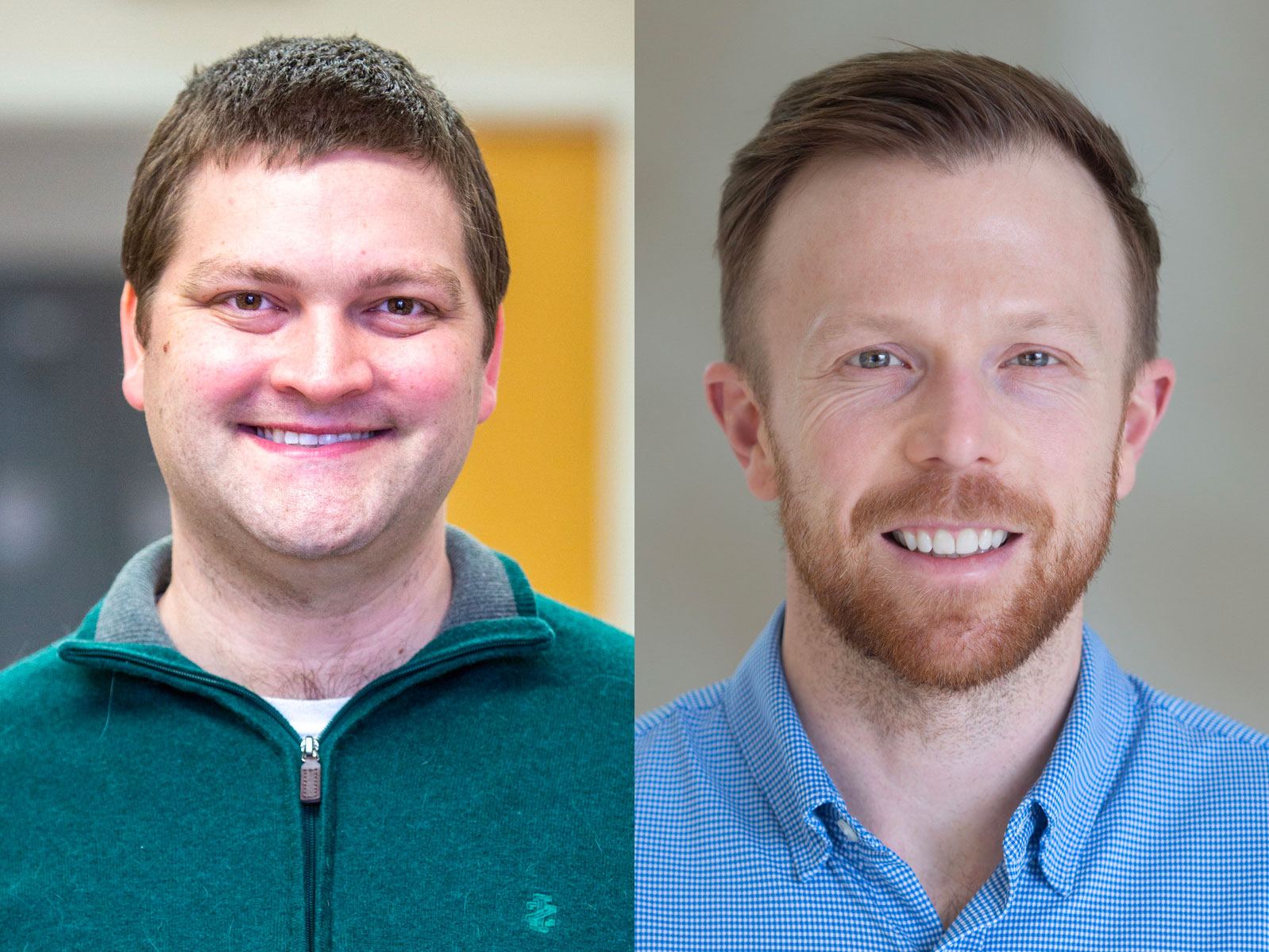
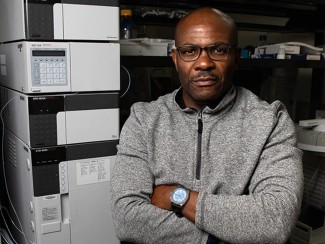
Danny Parrell, teaching faculty, UW–Madison Biocore program
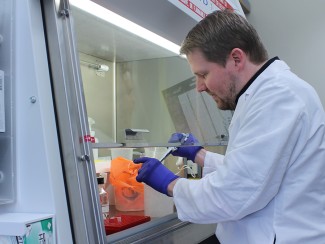
Kyle Probst, Experimental Fermentation Lab leader at the Great Lakes Bioenergy Research Center; (Google scholar profile)
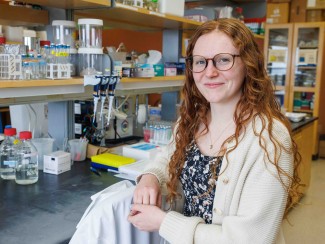
Ella DeRosier, UW–Madison alum and native food forest project manager
Credits
Nalina Cherr, writer/editor/host
Theme song written and performed by Graham Goodman (Listen on Spotify; follow on Instagram); “Silly Intro” by Alexander Nakarada (CreatorChords); “Time Stands Electric” by DJARTMUSIC (Pixabay)
Transcript
Unidentified female speaker 0:00
Where do you work?
Nalina Cherr 0:01
I work at the Wisconsin Energy Institute.
Unidentified female speaker 0:03
Where do you get all your energy?
Nalina Cherr 0:14
Welcome to Energy 101. This season, I'm on a quest to tell people what I do all day. Last episode, we toured a chloroplast and saw firsthand that when we say plants turn sunlight into food, it is just that simple and just that complicated. This episode, we're gonna undo all their hard work. What you eating there, Ella? This is really good corn. And with us is my friend Ella Derosier, along with something she's eating hot off the photosynthetic press.
Ella Derosier 0:42
I'm eating sun energy.
Nalina Cherr 0:55
Ella Derosier just graduated this past spring from UW Madison with two bachelors in science, one in global health and one in environmental studies. She worked as a camp counselor this summer and is currently working on starting her own business. But I brought her in to talk about something a little bit less professional. When you eat food, you break down all the sugars that plants made to store energy. Well, you and the tiny little microbe kind of things inside of you. Today, I actually want to talk with little friends that work right inside of every single one of yourselves. With who?
Daniel Parrell 1:37
Hi, I'm Morty, the mitochondrion.
Nalina Cherr 1:40
I was gonna take you on another miniaturizer tour, but I think I broke the quantum regulator last week, and the Do It Help Desk hasn't returned it to me yet. So instead, I'm gonna use the maximizer. Hi, Morty. It's good to have you with us. Would you mind starting the show by introducing yourself to our listeners?
Daniel Parrell 1:59
Yeah, of course. Hi, I'm Morty, the mitochondrion.
Nalina Cherr 2:03
Spoiler alert: This is actually Danny Parrell. He's a real scientist, I promise. But we'll talk about that later. Often called the powerhouse of the cell, mitochondria are cellular organs or organelles that provide energy for our cells. But unlike organelles like the nucleus or the Golgi apparatus, mitochondria have their own genetic code, which is kind of crazy if you think about it. Like all of our cells share an instruction manual, and everybody just reads their little chapter. Like your heart cells read the heart chapter, and you know your skin cells read the skin chapter. But mitochondria have an entire different playbook that even replicate themselves separately from the cell.
Daniel Parrell 2:41
The cell has oversight over when I replicate, but I'm self-directed.
Ella Derosier 2:46
Our cells-they're so complicated and complex, and yet inside each one, no matter how different they are, they all share this little guy, who's the same, and he just kind of does his own little thing.
Nalina Cherr 2:57
Yeah, it's kind of crazy. It's like kind of like if you had a little monster instead of a stomach, and when you ate, he like you didn't even swallow. He just like ate down your food for you. Which actually, now that I think about it, like microbes inside your gut do kind of chew to do your gut. Yeah, they do kind of do that. I mean, they're the ones doing the digesting, right? This sounds kind of familiar. I've heard that chloroplast also have their own DNA, and they started out as small cyanobacteria that were absorbed by bigger cells. Is that similar to your story?
Daniel Parrell 3:33
It's hard to say, of course. The family history is a little blurry, but I've met some bacteria with double membranes that look a lot like me, and their cell division looks a lot like my cell division. They're all gram-negative bacteria, and I wonder if I'm related. But I can't find my great grandparents' birth records. They still let me come to the family reunion every year, though, as long as I make my famous Jell-O salad.
Nalina Cherr 4:01
And what is it you do for the larger cell?
Daniel Parrell 4:05
You can kind of think of me as a currency exchanger. I take one type of energy currency, the sugars broken down during glycolysis, and I exchange them for adenosine triphosphates or ATP that can be used by the body. It's a pretty good deal for me. I get a constant flow of sugars and nutrients, and it's a pretty good deal for the body because I'm more efficient at making ATP than anyone else around.
Nalina Cherr 4:31
Morty isn't the only one that makes ATP. Chloroplasts can do it too. In plants, when chloroplasts break down water, they make oxygen and hydrogen ions, and if you think about hydrogen, it's the very first element on the periodic table of elements. So it only has one proton to begin with, and if you take away its one electron, it has a positive charge, and it's just a single proton. Protons are what make ATP generation happen. Think about ink. In water, it spreads out. That's how protons work too. Chloroplasts and mitochondria trap protons on one side of a membrane. The protons they don't like all being on the same side and having this concentration difference between the two sides of the membrane, so they want to cross the membrane and even everything out and achieve equilibrium. But there's only one way they can do that, the ATP synthase. The ATP synthase ends up doing work that I'm going to compare to like a loading dock. Let's say an adenosine truck drives by. It's got two phosphates in the back, so that makes it an adenosine one, two -- diphosphate. It's already pretty full. Stacking a third phosphate in the truck would take a lot of work, but the loading dock has a nifty little machine. Protons going through the membrane turn a crank. That work lifts a third phosphate energetically upwards, so it can fall right on top of the truck, making what would usually be a very difficult task pretty easy. Tell me a little bit more about this process. I understand that you trap protons on one side of a membrane, and then those are what run the ATP synthase. But how do you actually get the protons there in the first place?
Daniel Parrell 6:13
ATP is a really expensive molecule to make. In order to make it, I make a bunch of investments. I trade molecules across my membrane, those protons I was talking about earlier. The electron transport chain helps me do that a lot.
Ella Derosier 6:28
The electron what now?
Nalina Cherr 6:30
Nah. The electron transport chain.
Daniel Parrell 6:34
No, no, no. It's not so bad. You can think of it like an electron water wheel. Electrons flow downhill in a series of chemical reactions, and this is coupled with an uphill movement of protons across my inner membrane. Eventually, the electrons end up as water, and those protons drive my ATP synthase. Okay.
Nalina Cherr 6:55
Okay. So this whole electron transport chain and this series of reactions, I can kind of think of it like controlled combustion. Like if you burn sugar, you would end up with the most stable products possible, which would be water and carbon dioxide. And you make the exact same things, just with a lot of intermediates that really suck to memorize.
Daniel Parrell 7:13
Yes, I use sugars and break them down into energy and carbon dioxide. I just use the energy to make ATP instead of fire.
Nalina Cherr 7:25
And I've heard that kind of like combustion, you have to use oxygen to do that. Can I ask why?
Daniel Parrell 7:32
Well, ever since the Great Oxygen Revolution, oxygen has been one of the most abundant molecules in the atmosphere. It also accepts electrons very well, so it's useful to the electron transport chain. Many microbes actually use alternative electron acceptors. These alternative electron acceptors allow bacteria to use resources that other microbes cannot.
Ella Derosier 7:54
What's an electron acceptor?
Nalina Cherr 7:56
Okay, so if you're thinking about the electron transport chain, you're sort of thinking about an electron water wheel. You're thinking about like a series of reactions that flow energetically downhill in a series of like favorable reactions. You with me? Cool. So what an electron acceptor is is it's kind of like the basin of where all the water is falling into. It's like the lowest energy place those electrons can flow to,
Ella Derosier 8:22
like a good analogy for what an electron acceptor is, is it's like imagining a really big waterfall and then another waterfall and then it feeds into another waterfall and at the very base there's a pool and that's kind of where everything migrates to at the very base.
Nalina Cherr 8:37
Yes, in a lot of cases that's oxygen because it attracts electrons, and there's a lot of it conveniently floating around in the atmosphere, but other things can be used as electron acceptors. They just might be less good at it than oxygen.
Quick demonstration corner moment here, but we're not setting anything on fire this time because this is a cellular respiration episode and we're all about electron transport chains here and lab safety. For this experiment, you're going to need a tall, clear plastic bottle, a bunch of mud from your local mud dealer, and a little patience. Fill the bottle with mud and wait a few weeks. Eventually, you're gonna see layers of different electron acceptor users, just like you would in soil. Streaks of dark green, orange, and even purple. For more details on this experiment, I'm gonna link a Scientific American guide to the project called a Weinigradsky column.
Let's say for a minute that you could, you know, you're obviously living in a bigger cell and doing things for the cell. But if you could escape your containment, if you could go out into the world, if you could do anything else with your life other than making ATP for a bigger cell, what would you do?
Daniel Parrell 9:55
I've actually lost the ability to do glycolysis. The cell breaks down sugars for me, but I've always wanted to try it myself. Maybe even get into fermentation. I think if I could leave the cell, go out into the world, I'd like to try respiration without oxygen. Maybe try other electron acceptors like iron, or get into brewing.
Nalina Cherr 10:17
Thank you so much for talking with me, Morty.
Daniel Parrell 10:19
No problem. Happy to talk,
Nalina Cherr 10:21
and also thank you so much for playing along with me, Danny. As foreshadowed earlier this episode, Danny is a real person. Danny Perell is the high impact practice facilitator at the University of Wisconsin Madison's BioCore program, and also used to be a researcher at the Wisconsin Energy Institute.
Daniel Parrell 10:39
Thanks for having me.
Nalina Cherr 10:41
Thank you so much for playing this game with me. But aside from pretending to be mitochondria, you do have a real degree. You did microbiology, right?
Daniel Parrell 10:51
Yes, that's correct. I have a bachelor's degree in microbiology and a Ph.D. in microbiology and molecular genetics.
Nalina Cherr 10:59
And that's so like itty bitty things.
Daniel Parrell 11:02
Yes, itty bitty
Nalina Cherr 11:03
biology, but itty bitty.
Daniel Parrell 11:04
Yeah.
Nalina Cherr 11:05
As a microbiologist,
Daniel Parrell 11:06
yeah,
Nalina Cherr 11:07
do you feel like there are there's any way you think about mitochondria differently, like like thinking about it as a biological system rather than just as an independent organelle?
Daniel Parrell 11:18
When I think of mitochondria and how they likely arose, which is through an endosymbiotic event.
Nalina Cherr 11:25
That means a big cell absorbed a little cell.
Daniel Parrell 11:28
It makes me think about the different examples of kind of those base relationships that would probably start as parasitism in microbiology.
Nalina Cherr 11:38
And would that be the big cell parasiting off of the little cell and trying to swallow it, or like the other way around.
Daniel Parrell 11:45
It could be both. So yeah, we have examples of bacteria or things like amoeba that will absorb a smaller bacterial cell, kill it, and then eat all the nutrients and nucleic acids that it has.
Nalina Cherr 12:02
I mean, that's what we do, right? Like we eat animals and absorb their juices
Daniel Parrell 12:05
all day long, right? There's a species of bacteria called a , and they invade other bacterial cells. And you can think of this as kind of closer to that maybe ancient parasitism relationship where we have a bacterial cell invading another bacterial. This probably started out as parasitism, and over you know maybe thousands or even millions of years, it had to evolve into what we see today in eukaryotes.
Nalina Cherr 12:38
You sent me this really cool paper that was basically saying that mitochondria, they kind of lost the ability to do glycolysis, but probably had the ability to break down sugar at one point, and then because they were in this bigger cell that would do it for them, just kind of gave up the ability, and then in turn, like the big cell gave up the ability to do something else too. So it's really interesting the way they like, almost like fill each other's like ecological niches.
Daniel Parrell 13:02
Yes. Yeah. If you if you look at the mitochondrial genome, the the loss of certain pieces of central metabolism by a mitochondrion is indicative of a really like ancient symbiosis between the eukaryotic cell, which we could think of as the host, and the mitochondrion, which we could think of as kind of this abducted or absorbed microbe,
Nalina Cherr 13:32
our cells have become so interconnected with mitochondria that one cannot live without the other. But mitochondria aren't the only microbes humans have a symbiotic relationship with. Danny actually lent me a book recently on the topic of food and the microbes we use to preserve it. It's called Wild Fermentation by Sandor Alex Katz. I need more yogurt. Another great segue. We need to talk about fermentation. When cells don't have access to oxygen. One option they have is to skip the electron transport chain entirely and to just keep breaking sugar down. This process makes a lot of really interesting side products, like the lactic acid that makes yogurt taste good, and the alcohol in wine. And this process is called fermentation.
Daniel Parrell 14:21
In a class I took once, I thought that our instructor had a really clever way of saying it. Fermentation is just controlled rotting.
Nalina Cherr 14:30
Oh,
Daniel Parrell 14:31
because you know we think of rotten food as something that we could never eat. It's putrid. It smells awful. It's kind of the same thing as when we have microbes that ferment our food, but we like what the fermenting bacteria are making, and and so it's a matter of of kind of cultivating what you like about that fermentative process.
Ella Derosier 14:58
Wait, what does this have to do with your job?
Nalina Cherr 15:01
Oh, it's so related. Here to prove it is is somebody who works at the Wisconsin Energy Institute itself. That after the break.
Unidentified female speaker 15:13
Are you sick of food waste? Do you feel bad about throwing out banana peels? So do I. Which is why I'm offering limited edition, gold star exclusive, sea turtle approved fermentation kits. Our kits are handmade without child labor or animal testing, lovingly stocked with organic goodies like peach pit, burnt toast, carrot top. That's like some carrot cake that got pawned off by my roommate at Entomology Club. Each kit is certified with active microbial action. Open the box; you can smell it right away. Powerful kids love it. Buy it for your grandkids. Buy it for your cousins. Buy it for birthdays, quinceañeras, bar mitzvahs. That one guy from high school visits last who keeps trying to follow you on Instagram. Let it go, man. Don't wait. Order yours today, and we'll throw in a free maggot infestation and a magazine subscription to our newsletter, carefully curated from a selection of brochures handed to me on campus. Wow, I didn't know Lifesaver Club met on Wednesdays.
Nalina Cherr 16:15
We're back, and with us is Kyle Probst, experimental fermentation lab leader at the Wisconsin Energy Institute and Great Lakes Bioenergy Research Center.
Kyle Probst 16:24
Really, what drew me to microbes, especially fermentation, is their versatility as biocatalyst. During my master's program, I had a mentor who was not a microbiologist. He was actually an agricultural engineer, but working with him, he really instilled the idea of turning low-valued inputs, like waste streams, into something valuable. Microbial fermentation is like the ultimate version of that idea because you can really use the microbes as a catalyst to then you know convert things of low value into higher value. Things like underutilized resources into fuels and chemicals, foods, even therapeutics. So I view it as biology with purpose, and it turns waste into opportunity.
Nalina Cherr 17:07
Fermentation is rampant at the WEI. I actually talk to a lot of scientists who are trying to turn cow manure into plastic. Lots of stuff that's usually made from crude oil, and they're trying to make it from resources that are currently just being tossed in the trash.
Kyle Probst 17:20
What is fermentation? It's a way for organisms to generate energy under conditions where there's no oxygen present, right? And and we're most familiar with yeast being able to do this, and they produce ethanol as a byproduct. But I think of fermentation as being something even broader than that. I consider it to be really any time you're using an organism to convert something, usually something of lower value into something of higher value.
Nalina Cherr 17:50
Just to be clear, the scientific definition of fermentation is the chemical process that breaks sugar down for energy in the absence of oxygen. But for the purposes of talking with Kyle and discussing the Wisconsin Energy Institute are actually going to include things like protein production by microbes and other examples of what Kyle describes as low value input, high value output that are not covered by the definition you might find in your biology textbook.
Kyle Probst 18:15
I like to think of it as a process where microbes act as a bio catalyst and they transform something into a product we find useful. Could be fuel or it could be medicine. But there are some examples where this is done industrially. And believe it or not, some of the oils that are found in baby formula,
Nalina Cherr 18:33
whoa,
Kyle Probst 18:34
fermentation. Yeah, some of these polyunsaturated fatty acids that are really important to brain health are actually made via fermentation. You know the enzymes in your detergent come from from microbes.
Nalina Cherr 18:47
And after your PhD, I know you you said you worked in bio like industry type. So what did you do there?
Kyle Probst 18:56
Yeah, so I worked at I've worked at a few different places. My first job out of school, I worked at what's known as a corn wet mill. I also call it a corn bio refinery, but corn goes in and a variety of products come out of it. And one of the processes that was used there was fermentation. It was to make alcohol from Saccharomyces cerevisiae or yeast. The last place I worked before I came here to WEI, I worked for an international food ingredient company, and one of the areas that they supplied products into was the biotech biopharma industry. We weren't supplying food for people; we were supplying food for microorganisms. So we made ingredients like yeast extracts and peptones and protein hydrolosates, things that you might find, you know, in a in a microbiology lab for growing microbes. We were selling metric tons of this material into the industrial biotechnology industry. A lot of biopharma that makes biological drugs, they rely on. Nutrients to feed their cells, right?
Nalina Cherr 20:02
So, like vaccines, yeah,
Kyle Probst 20:04
vaccines would be a big one. You know, therapeutic proteins,
Nalina Cherr 20:09
insulin.
Kyle Probst 20:10
Insulin is one. Yeah, insulin is a good example of one that's made via microbial fermentation.
Nalina Cherr 20:15
Fermentation has a whole lot of industrial applications, and it's also a cornerstone of the research at the Wisconsin Energy Institute, this episode is running on over 20 minutes, so Kyle will tell us all about that side of his work next episode. Okay, that was kind of a lot, so I'm going to recap real quick. Our cells break down sugars and other carbon structures and use their electrons to produce energy that can be used elsewhere in the body, like in muscles. This process is performed most efficiently in mitochondria, which have their own DNA and probably started as separate bacterial cells. Mitochondria need oxygen to work, but there's a lot of microbes that use other strategies. One of these strategies is called glycolysis, also known as fermentation. And fermentation makes a lot of cool things like lactic acid and ethanol. Next episode, we're going to talk about how ethanol isn't just alcohol; it's also biofuel. We'll talk to some scientists about how they make alcohol in labs and some of the problems faced in the quest for sustainable energy sources, this episode was written, hosted, and produced by Nalina Cherr. The mitochondrion section was co-written in collaboration with Danny Parrell, and the fermentation kit ad was brainstormed in collaboration with Aisha Goodman. Morty the mitochondrion was played by Danny Parrell. Our special guests were Danny Parrell, Kyle Probst, and Ella Derosier. If you want our sources and a few little extra tidbits about mitochondria and other cool stuff, I'm gonna leave those all linked in show notes. Today you heard "Silly Intro" by Alexander Nakarada and "Time Sounds Electric" by DJARTMUSIC. Our theme song is written and produced by Graham Goodman, aka Authentic Graham. You can check out his other music on Spotify or on Instagram at Authentigraham, you can check us out on Instagram too at UW Energy Institute for updates on this podcast and all the other wonderful Wisconsin Energy Institute programming.
Music 22:19
Wisconsin energy institute. Energy 101.
Transcribed by https://otter.ai