Link to Wisconsin Energy Institute home page

Wisconsin Energy Institute

Forward in Energy

Main navigation

  • About
    • About Home
    • WEI Building
    • Leadership
    • Investigators and Affiliates
    • Energy Experts
    • Land Acknowledgement
    • Career Opportunities
    • Energy Boost Shout-outs
    • Digital Accessibility
    • Contact Us
  • News
    • News Home
    • 175 Years of Energy Research
    • Badger Energy Bulletin
    • Postdoc and Student Spotlight
    • Newsletter
    • Media Resources
    • Propelling Women in Power Podcast
    • Watt's Up Wisconsin Podcast
  • Research
    • Research Home
    • Electricity Systems
      • Overview
      • Building Efficiency
      • Electricity Distribution
      • Geothermal
      • Materials
      • Microgrids
      • Nuclear
      • Solar
      • Storage
      • Supercritical Fluids
      • Wind
    • Transportation & Fuels
      • Overview
      • Biofuels & Bioproducts
      • Conversion
      • Engine Research
      • Plant Deconstruction
      • Plant Genetics & Breeding
    • Sustainability & Society
      • Overview
      • Economics
      • Environmental Studies
      • Policy & Regulation
      • Science Communication
      • Sustainable Agriculture
      • Water
    • UW–Madison Energy Research Centers
    • Resources for WEI Researchers
  • Industry
    • Industry Home
    • Technology Highlights
    • UW–Madison Spinoffs
    • How To Partner
  • Education
    • Education Home
    • Education Events
    • For Educators
      • For Educators Home
      • Educational Materials
      • External Resources
      • Visit Us
      • Climate Solutions Workshops
    • For Students
      • For Students Home
      • Research Opportunities
      • Academic Programs
      • Career Resources
      • Student Organizations
    • KidWind Challenge
      • Kidwind Challenge Overview
      • 2026 WI KidWind Challenge
      • Past Challenges
      • Kidwind Educator Workshops
    • Energy Transitions Oral Histories Project
  • Events
    • Events Home
    • Forward in Energy Forum
    • Sustainable Energy Seminar Series
    • Circular Bioeconomy Workshops
  • Give

Breadcrumb

Home News Salvation through fermentation

Salvation through fermentation

December 20, 2017 Krista Eastman
WisContext

https://www.wiscontext.org/salvation-through-fermentation

Research Center

Great Lakes Bioenergy

Research Areas

Conversion

Related Researchers

Chris Todd Hittinger

Related News

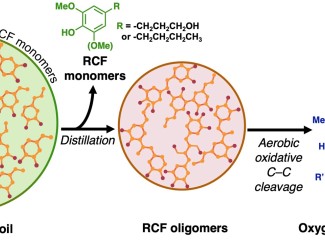
flow chart illustrating the conversion of poplar or pine biomass into value-added products. The process begins with reductive catalytic fractionation of the biomass to produce RCF lignin oil, separating out cellulosic pulp. The oil undergoes distillation to remove monomers, leaving RCF oligomers. These oligomers are then processed through aerobic oxidative C-C cleavage to create oxygenated monomers. Finally, bioconversion turns these monomers into the final products: PDC or muconic acid
Catalytic reaction maximizes product yield from plant fibers
December 01, 2025
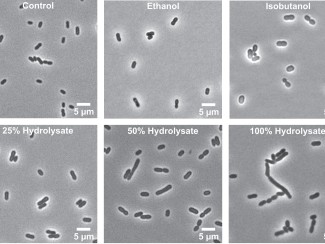
Bright-field microscopy images showing Z. mobilis bacterial cells under six different treatment conditions. The top row shows Control (normal rod-shaped cells), Ethanol treatment (cells appear slightly enlarged), and Isobutanol treatment (cells show some swelling and morphological changes). The bottom row displays cells exposed to 25%, 50%, and 100% lignocellulosic hydrolysate concentrations, showing progressive cellular stress with increased elongation, chain formation, and morphological distortion at high
Systems-level analysis shows how treated biomass affects microbes
November 04, 2025
Cartoon illustration showing two anthropomorphized microbes with caps (one coral-colored, one teal) collecting phenolic compounds from poplar trees. The trees display molecular structures of phenolic compounds (showing benzene rings with OH groups). One microbe operates a cart filled with collected phenolic molecules, while the other holds a collection tool.
Microbes turn hazardous waste into valuable products
October 14, 2025
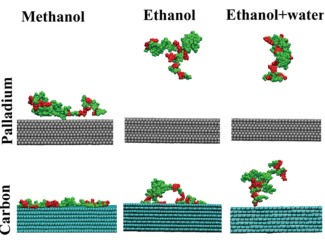
Six ball-and-stick models of lignin oligomers shown in relation to palladium (gray) and carbon (teal) surfaces in three solvents. In methanol, oligomers are close to the palladium surface and lie flat on the carbon surface. In the other two solvents, oligomers are far from palladium and tangentially touching the carbon surface.
Atomic-level modeling offers insights on biomass deconstruction
October 13, 2025
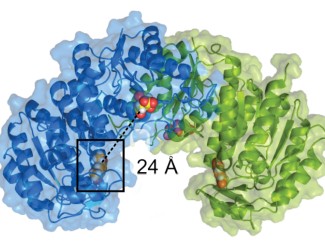
A molecular rendering of a homodimer protein complex showing two identical subunits colored in blue (left) and green (right). Each monomer contains bound citrate molecules (yellow spheres) and acetovanillone molecules (orange spheres). A black rectangular box highlights a specific region in the blue subunit, with a measurement indicating "24 Å" distance. The protein structure displays typical secondary structure elements including alpha helices and beta sheets in ribbon representation.
Newly discovered protein expands microbial palates
September 02, 2025

Image of Crest links to wisc.edu

Image of GLBRC logo links to glbrc.org

Resources

  • For Researchers
  • For Students
  • For Educators
  • For Industry
  • For Media
  • About Us

Quick Links

  • Energy Experts
  • Subscribe to our Newsletter
  • Great Lakes Bioenergy

Support

Support the Wisconsin Energy Institute by making a gift to the University of Wisconsin Foundation. Help us continue to move the state, nation, and world forward in energy.

Give Now

Contact

Address:
1552 University Ave.
Madison, WI 53726

Contact Us

Follow Us

UW–Madison

Positioned within the UW–Madison's Office of the Vice Chancellor for Research, WEI is the collaborative home of energy research and education on campus.

Feedback, questions, or accessibility issues: communications@energy.wisc.edu

Privacy Notice | © 2023 Board of Regents of the University of Wisconsin System.

Site icons More open menu close search search search envelope twitter youtube facebook instagram Collapse Expand next slide previous slide map-marker Footer Crest GLBRC Logo linkedin