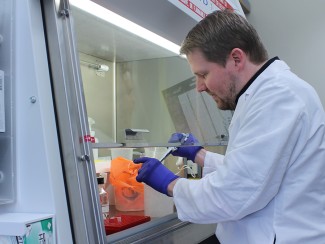
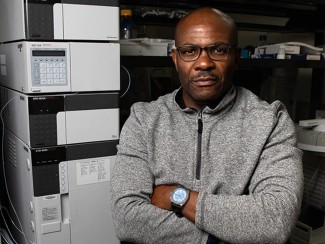
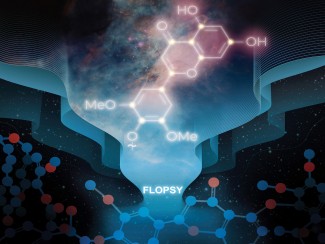
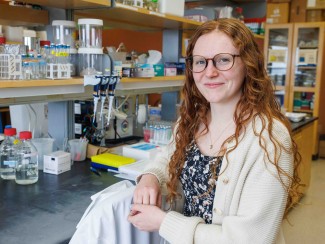
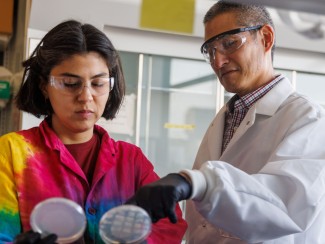
Botanist/mom Aisha Goodman convinces our host plants are so important they need a whole episode and biochemistry professor Chris Gisriel takes her on a tour of photosynthesis to learn about where plants get their matter. Things go a little haywire when the miniaturizer is broken and our host and her guest are flung backwards in time to learn why plants matter.
Welcome to Energy 101, the podcast where Wisconsin Energy Institute communications intern Nalina Cherr brings experts questions both nebulous and microscopic about energy and leaves with more than she came with.
Episode 2: Show notes
By the end of this episode I hope you’ve learned something about these things:
- Most biological energy comes from the sun.
- Plants can use sunlight to capture carbon into sugar via photosynthesis.
- This process happens via a series of chemical reactions, held together by big protein blobs (complexes) including photosystems.
- These protein blobs hold chlorophyll and other molecules.
- Sunlight “excites” electrons in chlorophyll.
- This energy has to go somewhere (just like the heat in a hot cup of tea) so it bumps into other electrons until eventually sugar can be made.
- Plants store carbon in different forms for different purposes.
- Sugars like glucose are easier to break down and are for short term energy storage, structures like lignin and starch are more complex and serve purposes including long term storage and plant structure.
Fuel for future episodes
- What types of carbon structures do people break down for energy?
- How do plants use energy once they store it in carbon structures?
- Energy isn’t a physical substance, but more of a description of whether an atom is “uphill” or “downhill” — how does this property allow us to store, convert, and transfer energy? Is there a better way to talk about it?
Sources and further reading
- Becker’s World of the Cell 10th Edition by Jeff Hardin and James P. Lodolce (This is the textbook from my biology class. It was referenced for the explanation of myosin as well as ATP and is a book I’ve spent a lot of time reading for academic reasons and therefore doubtless spread insidious seeds of learning.)
- Gisriel Lab (Chris Gisriel and his lab take cool pictures of photosystems and make lots of neat models. You can see some of their visualizations (and other lab shenanigans) in the gallery section of his website. Bonus: you can also check out some of his publications.)
Guests

Chris Gisriel, assistant professor of biochemistry, UW–Madison
Paul Hooker, senior lecturer, Department of Chemistry, UW–Madison
Ella DeRosier, UW–Madison alum and native food forest project manager
Credits
Nalina Cherr, writer, editor, host 
Theme song written and performed by Graham Goodman (Listen on Spotify; follow on Instagram)
Other tunes: “Freedom Bike” by Dagored (FreeToUse); “Action Energetic Rock Music” by Ikoliks (Pixabay); “Silly Intro” by Alexander Nakarada (CreatorChords); “Cowboylong” by Eduard Bykovets (Pixabay); “Happy Cooking” by GoldenSoundLabs (Spotify)
Transcript
Nalina Cherr 0:00
All right, and I'm gonna start recording. Oh, the pillow fort is falling! Oh my gosh, I need to get it to have a little this way tension. Better, maybe.
Aisha Goodman 0:10
Don't you want to talk about plants?
Nalina Cherr 0:12
Okay, like what? Because you're botanist.
Aisha Goodman 0:15
Because photosynthesis is what keeps everything alive. Okay, fine. I guess I guess I did hear that from an expert somewhere.
Chris Gisriel 0:28
There's not much more sort of fundamental metabolic processes than than photosynthesis, right? It's something that defines our atmospheric and and geological composition, gives rise to all higher life on Earth.
Nalina Cherr 0:50
Hi, my name is Nalina Scher. I'm a communications intern at the Wisconsin Energy Institute and an undergraduate at the University of Wisconsin Madison. You think I should memorize the Calvin cycle
Aisha Goodman 1:00
so that you can talk about it here.
Nalina Cherr 1:02
Yeah, is that even relevant?
Aisha Goodman 1:03
Tangentially.
Nalina Cherr 1:06
Welcome to Energy 101. This season, I'm trying to answer questions about my job, and then when I get stuck, I go to experts and leave with more questions than I came with. Last episode, we talked to my freshman year chemistry professor, Paul Hooker, and hopefully, you came out of it understanding a little bit more about why chemical reactions happen at an atomic level. Now we're going to get just a little bit bigger and discuss the molecules that convert sunlight into a whole lot of usable energy and the atomic properties that let that happen. This is a four-part series. You're listening to part two, plant matter. You could also call it plants matter. Oh, like like plants are important, and also and also like plants. That'd be kind of cool.
Music 1:58
Wisconsin Energy Institute.
Nalina Cherr 2:10
With me is Aisha Goodman, a Bachelor of Science in Botany.
Aisha Goodman 2:15
The thing you need to know about plants is that it all comes from the sun.
Nalina Cherr 2:20
Plant enthusiast, sewing machine tanker, seamstress, and my mother.
Aisha Goodman 2:25
And plants are really amazing because what they do is they turn the energy from the sun into energy, like chemical energy that like you can turn into energy in your body. And if it wasn't for that, we'd all be dead on a rob, we wouldn't even exist. We wouldn't even be nothing. None of us exist, right?
Nalina Cherr 2:45
At its most basic level, photosynthesis is the process by which plants take in light, carbon dioxide, and water, and create sugars that can be used as energy. In my bio class, we've discussed photosynthesis. We've memorized things like light and dark reactions and the Calvin cycle and so forth, but all the chemical reactions I've memorized don't really seem to stick in my head. What I'm really stuck on is all the actual physical conversions of light. Like when we say plants take in light, what does that literally physically mean? So I brought my questions to another expert.
Chris Gisriel 3:23
I'm the first person ever in human history to see what that molecule looks like.
Nalina Cherr 3:30
This is Chris Gisriel. He's an assistant professor at the University of Wisconsin Madison in the biochemistry department, and I think if anybody can help us understand some of the mechanics of photosynthesis, it's Chris. Chris actually takes pictures of photosystem, the molecular scaffolding that houses the chemical reactions behind photosynthesis.
Chris Gisriel 3:51
What we do is we take pictures. In in many ways, it's it's can be thought of like a a camera, really a microscope. We take pictures of proteins, and we take those pictures and we make, and they're two-dimensional pictures, right? And we can use those to stitch together 3D reconstruction, and that's what we call a map. Very often, when I gain gather those pictures, and I look on my computer and I'm looking at this map. I'm the first person ever in human history to see what that molecule looks like.
Nalina Cherr 4:31
But before we talk about these molecules, let's get tiny. Now we're tiny. A
Chris Gisriel 4:38
million times smaller than the smallest thing that you can see.
Nalina Cherr 4:43
That's right. We have a miniaturizer. This is a high-budget show. Welcome to the chloroplast, the cellular organ or organelle that performs photosynthesis. If you look to your right and to your left, you'll see tall pillars. These are called thylakoid membrane. And the thylakoid membrane kind of looks like a big battery stack or a stack of pancakes. Stuck through those membranes with huge twirling helixes and grinding cogs are photosystem complex proteins.
Chris Gisriel 5:12
Really, the protein serves as a scaffold for other small molecules.
Nalina Cherr 5:17
These photosystems act like big molecular factories, holding all the reactions that add together into photosynthesis. If you were to like describe it for somebody, like say you were like looking at it, you've taken a lot of pictures of these. Like, what is it? What does it look like? Is it a big blobby mass? Is it like very rigid?
Chris Gisriel 5:35
I suppose I could argue that all proteins, you know, to some extent, are big blobby mass. Big blobby mess. Yeah, yeah, exactly.
Nalina Cherr 5:42
Go ahead and touch it. Bloop, bloop, bloop. This is maybe a silly question, but like, if I touched it, would it be like sticky? It looks like it would be sticky.
Chris Gisriel 5:49
Protein is sticky. Okay. Yeah, protein is sticky. That is that is true. That's the texture of protein.
Nalina Cherr 5:56
If you want to see the weird blobby light factory for yourself, you can see the pictures Chris takes in the gallery of his lab website. Links in show notes. Chris told me that these protein complexes are especially blobby because they hold a lot of small, important, not protein molecules, including chlorophyll, the molecule that gives plants their unique green color by absorbing all the other light. And when we say that like plants absorb light and then convert it into chemical energy. Is there like a particular part of the molecule that like vibrates faster when the light hits it? Like what's what's going on in there?
Chris Gisriel 6:32
Actually, that's really excellent intuition. That is exactly what happens. Yeah. So essentially, when a photon strikes one of these chlorophyll molecules. Its electrons go into high energy states, and you can think of that like energetic electrons. And those are essentially moved around from molecule to molecule. And eventually, what happens is a high energy electron is kind of kicked off, if you will, into metabolism.
Nalina Cherr 7:06
Remember how in episode one we talked about how all things like to be as stable as they can be.
Paul Hooker 7:12
Really, chemical potential energy is just a kind of a movement, a shift of these charge distributions that you find in molecules. And if they make a stable molecule, that charge distribution has been somewhat optimized.
Nalina Cherr 7:24
Paul Hooker, professor of chemistry, told me to imagine a warm cup of tea. Hold it in your hands. Right, it's warm. Your hands feel warmer just touching it. Now, leave it in the room for a while, and you know that the heat in the mug will disperse. You'll come back to a cooled cup of tea.
Paul Hooker 7:41
In the end, that energy in the tea is actually trying to spread out as much as possible.
Nalina Cherr 7:46
The universe is a lot like that too.
Paul Hooker 7:49
Whenever you try and concentrate energy, be it heat, for example, or even chemical potential energy in a in a small environment, it has its natural tendency to spread out. Everything changes, and in the end, everything is going to be spread out.
Nalina Cherr 8:03
We're all nearing homeostasis.
Paul Hooker 8:05
I guess so. And if you take it to the planet Earth, for example, I guess the prediction is that one time our sun, through its life cycle, is going to grow very big and swallow the Earth, and then I guess maybe a supernova, our everything, all the atoms we're made of that came from the sun, are just going to be spread out to the greater part of the universe. There's not really a lot we can do about it except enjoy the ride.
Nalina Cherr 8:26
Plants and the molecular reactions inside them work the same way as the rest of the universe. When light is absorbed by chlorophyll, electrons get excited. They want to get rid of some of that energy and end up like the rest of the universe in homeostasis. So they pass off some of that energy to their neighbors. When those electrons get excited, the do the electrons literally move, or are they bumping into other electrons down the line and like more like a wave in a slinky as opposed to like throwing a hot potato down the line?
Chris Gisriel 8:57
So both
Nalina Cherr 8:59
sun energy first is passed through a photosystem like a wave in an ocean, with vibrating electrons bumping into electrons further down the line. And I say down because the energy is moving to more and more stable molecules, just as water will flow downhill. Then it hits the special molecules,
Chris Gisriel 9:17
the the special pair of molecules.
Nalina Cherr 9:19
They have names P700 and P680, depending on which photosystem you're looking at. But I'm going to call them the special pair. This special pair of molecules has a unique property. It starts out super low energy at the bottom of the energy valley, but when the energy wave rolls in, its electrons get super excited, so excited that they can actually leave the molecule hot potato style. Then, when they leave, the special pair is now super positively charged. It's down a few electrons, so it's unstable. So unstable that it can actually pull electrons from water, the very stable product of combustion that usually doesn't want to go anywhere. And when it pulls electrons off of water, water will split into oxygen and hydrogen, which is how we end up with oxygen. And those hydrogen molecules-they're just single protons, positive charges that are necessary to make ATP production happen. And I'm hoping to talk about that next episode. And also NADPH, which is all you need to know about it is it's the energy currency necessary to fix carbon into carbohydrates and other sugars. So, by breaking down a stable molecule like water, you make things unstable, and that means the system will move until it reaches a new kind of equilibrium.
Aisha Goodman 10:38
So, in short, photosynthesis is basically one long Rob Goldberg machine designed to make sugar.
Nalina Cherr 10:45
Yeah, like sugar and also carbs and also wood and also lignin.
Aisha Goodman 10:49
Am I supposed to say something about lignin? Do
Nalina Cherr 10:51
you know what lignin is?
Aisha Goodman 10:52
Of course I do. Lignin is like the hard woody material that plant cells make. I used to grind up a lot of lignin.
Nalina Cherr 11:00
So you you are pretty experienced for our next experiment. Here, hold this.
Aisha Goodman 11:05
What what did you just hand me?
Nalina Cherr 11:07
It's a stalk of corn. Do you have a lighter?
Aisha Goodman 11:09
Is this safe to do and a pillow for it?
Nalina Cherr 11:14
Welcome to demonstration the corner, the corner where we put science into practice. This ear of corn has a lot of stored energy. We're gonna find out exactly how much. Can you hook up that Bunsen burner to the gas tank over there? It's plugged right in. To measure the amount of easily available energy in this piece of corn, we're going to use calories. Calories are measured Paul Hooker style by setting things on fire. One calorie is the amount of stuff it takes to raise the temperature of a gram of water by one degree. We'll start with the leaf. Mom, do you want to practice grinding that leaf up? I got a mortar and pestle right here. I didn't actually use a mortar and pestle. What'd you use? Um. Well, sometimes you'd stick it in a capsule with a ball inside and shake it around a bunch.
Aisha Goodman 12:01
Yeah, put it on those. Got one right behind you. That makes a lot of noise.
Nalina Cherr 12:08
All right, and then I'm gonna check on the Bunson burner. We'll start with the leaf. That's three calories and a half cup serving of corn leaves, as based on the USDA lettuce calories. This burns pretty well, but there's not a lot of easily digestible stuff. All right. Now the corn cob. Okay. I weirdly can't find any sources about the calories in a cob of corn. I don't know why cows. Probably because people can't digest corn cobs. Most of their energy is bound up in lignin and other complex carbon structures, which is kind of surprised why we don't eat it. Okay, pass me the corn kernels. Stop eating them. Why'd you pop them?
Aisha Goodman 12:51
They're delicious.
Nalina Cherr 12:52
It's about 66 calories. What's that hissing sound? Oh shoot! Turn off the gas tank. Beep beep beep. We're experiencing some technical difficulties, but don't touch that dial. We'll be right back after this brief word from our sponsors.
Unidentified male speaker 13:16
Hey, kids, are you tired of the same old breakfast stuff? Mom, I hate. hate warm corn flakes. Stop complaining and eat your breakfast. You should try Linky's crab-eyed frosted lignin cubes. Bam! Every cube is jam-packed enough yummy potential energy to kickstart the car. Mom, this is a bowl of wood chips. I'm not a micro album. Eat your dirt. It's not dirt. Slides, cracked, hot frosted lignin cubes. Already produced in three bold flavors, including switchgrass, poplar, and high fructose corn syrup. But wait, there's more. You can now get any of our flavors. Protein blasted. It's scurrumbiddly, anxious and healthy, but don't take it from me. Take it from my expert.
Chris Gisriel 14:06
You'll be like, oh, that's the texture of protein.
Unidentified male speaker 14:10
Licky is protein blasted crab fried frosted lignin cubes, soon to be found in paper mills and grocery stores near you.
Nalina Cherr 14:26
Is that the gas tank again? Nah, it should be fine. What's that sound? Hmm, it kind of seems like the miniaturizer is on the fridge. Oops. Before the break, we were talking with. Chris Giriel about some of the equipment that plants use to capture light on Earth, thus supplying most of the energy available on this planet. Where the heck are we? Well, we're not in the pillow fort anymore. Hang on, let me check the miniaturizer instruction manual. What is this sludge? Why is it so hot and smelly and oh, and hard to breathe? Hey, um, don't get mad or anything, but but what? I think we're back in time. Here, I'll try to tap into the local radio. The miniaturizer comes with an FM function.
Unidentified female speaker 15:34
The date is 3.8 to 3.5 billion years ago. The oceans are a balmy 135 to 181 degrees Fahrenheit, and they cover most of the planet. It's muggy today. The atmosphere is full of methane and water vapor and carbon dioxide. In today's political news, the comets and asteroids have finally built an interstate in a newer solar system. Up next, we have Sarah Stromadolite with a story about an entrepreneurial little green bacteria doing something totally, radically, respirationally new.
Nalina Cherr 16:13
You sent us back to the Archean Era?
I I don't think it'll last very long. Hey, look, there's Chris. You wouldn't happen to know where we are, would you?
Chris Gisriel 16:21
I don't know, three, three and a half billion years ago.
Nalina Cherr 16:25
I do have errands after this. What's all this green gloopy stuff in the water? It kind of looks like the blue green algae in Lake Mendota.
Chris Gisriel 16:33
Blue green algae are not algae; they are cyanobacteria. And when you look at like Lake Mendota, for example, that you just mentioned, you find both. You find cyanobacteria and you find algae.
Nalina Cherr 16:45
Cyanobacteria were the very first photosynthesizers, singular-celled bacteria that turned sunlight into energy. I feel like I actually read somewhere that the very first photosynthesizers were purple. So what's with all the green stuff?
Chris Gisriel 17:00
All photosynthesis started in an atmosphere that did not contain oxygen, and it did not produce oxygen. It started what we would say anoxygenic by anaerobic organisms. So, so we like to think about that because we say, okay, let's now look at the diversity of photosynthesis that exists today, whether it's producing oxygen or not, and can we again think about you know what what photosynthesis might have looked like that many that many years ago? And one of the model organisms that people frequently look at to try to understand anoxygenic photosynthesis are called purple bacteria, so I I think it might be the purple bacteria that are not cyanobacteria, but they they do anoxygenic photosynthesis.
Nalina Cherr 17:50
So they were doing photosynthesis before cyanobacteria?
Chris Gisriel 17:53
Exactly, before there was even oxygen in the atmosphere.
Nalina Cherr 17:56
3.4, 3.5 billion years ago, there wasn't a whole lot of oxygen in the air. That change was cyanobacteria, which pumped so much toxic oxygen into the atmosphere that they actually shifted the composition of it. The Great Oxidation Event, as it's sometimes called, makes it sound like it happened quickly, but really there was a slow, steady advantage given to organisms that used oxygen, and a very slow mass extinction event, which allowed those oxygen-using organisms plenty of space to grow and evolve.
Chris Gisriel 18:27
We find, and and this is actually a big problem, I suppose, problem in trying to understand the evolution of photosynthesis. When we look at oxygenic photosynthesis, we go as far back as we possibly can. We we consider the simplest possible system in oxygenic photosynthesis, and it still looks almost the same as much of what we see today. We can identify some of the bells and whistles, but it still looks like this really complex pigment protein thing sitting in the membrane.
Nalina Cherr 19:00
It's just complicated, no matter how you splice it.
Chris Gisriel 19:03
Exactly, exactly, and it's one you know, and that really kind of can't be right. So, so now we have you know you have to think even further back and say, well, how did that how did that come about? And and that you know, the further you go back in time, the more challenging it is to understand what happened.
Aisha Goodman 19:21
When we talk about things like phylogeny in botany? You're talking about the idea of like tracing existing plants back toward the common ancestors that we all have, and like sort of like charting like the basically like the evolution of life as we know it. Hey, the miniaturizer is hissing again,
Nalina Cherr 19:43
and we're back in time for you to go run your errands.
Aisha Goodman 19:46
Where is Chris?
Nalina Cherr 19:48
I'm I'm sure he'll get back fine by himself.
Aisha Goodman 19:51
So that's where plants come from.
Nalina Cherr 19:53
Plants are oxygen-filled atmosphere that allows for us all oxygen-using creatures, the sugars we depend on for energy, and even. Gasoline we use to power cars. Ah, that's part four stuff. Thank you so much for listening to Energy 101. This is a four-part season. You just heard episode two, Plants Matter. If you learned at least a little bit of something about something, or at least had fun. I hope to see you next episode, where we'll take a few deep breaths of all the wonderful oxygen produced by plants and meet one of my favorite, weirdly genetically independent organelles. I mean, besides chloroblasts. This episode was written and edited by your host Nalina Cherr with advice from Chris Hubbuch. Our special guests were Aisha Goodman and Chris Gisriel, with bonus audio from Kieran and Auden Cherr. This episode, you heard Action Energetic Rock Music by Ikoliks, Silly Intro by Alexander Nagarada, and Happy Cooking by GoldenSoundLabs. Our theme song is written by the man and the legend, my uncle, the Authentic Graham Goodman. You can find Graham on Instagram or on Spotify under the handle Authentic Graham. You can find us on Instagram too at UW Energy Institute, where you can follow us for updates on this podcast and all the other wonderful Wisconsin Energy Institute programming. We want to hear from you. Feel free to send us your comments, critiques, or suggestions through Instagram, email, or via Pneumatic Tube.
Transcribed by https://otter.ai