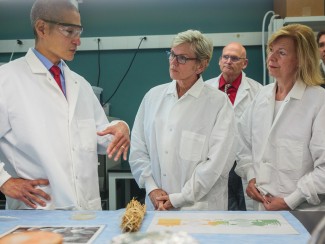
In which a history major asks “what is energy?” and our host tracks down chemist Paul Hooker for an answer. Things are set on fire, and workouts are maxxed out with professional trainer Eli Goodman.

Welcome to Energy 101, the podcast where Wisconsin Energy Institute communications intern Nalina Cherr brings experts questions both nebulous and microscopic about energy and leaves with more than she came with.
Episode 1 show notes
By the end of this episode I hope you’ve learned something about these things:
- Energy is a nebulous concept. This episode we are talking about chemical energy.
- Chemical energy can be compared to potential energy: Things with high energy fall like rocks off a cliff into lower energy states.
- Energy is neither created nor destroyed – it can only change from one form to another, kind of like money.
- Combustion releases energy because atoms in a less stable state end in a more stable state.
- Breaking bonds always requires an input of energy.
- One common form of biological energy is ATP (adenosine triphosphate).
- ATP does not release energy when broken down, but it’s highly unstable and forms more stable products during reactions.
- Creatine is real science.
- It works by binding extra phosphates in your muscles, ready to slap them onto ADP (ATP that has lost a phosphate) so you have more energy.
Fuel for future episodes
- How oxygen’s stability makes it important to biological processes.
- How plants can utilize the stability or lack thereof of atoms to store energy.
- How cells make ATP through respiration.
- All energy comes from somewhere.
- What we’re combusting in our car engines, and how we get it.
Sources and further reading
- Becker’s World of the Cell 10th Edition by Jeff Hardin and James P. Lodolce (This is the textbook from my biology class. It was referenced for the explanation of myosin as well as ATP and is a book I’ve spent a lot of time reading for academic reasons and therefore doubtless spread insidious seeds of learning.)
- Creatine as a Food Supplement for the General Population by Sergej M. Ostojic, Journal of Functional Foods (Used to fact check some sources of creatine and a pretty neat comprehensive article on the benefits of its use).
- Creatine by Mayo Clinic staff (A good place to start if you’re going to look at it for yourself)
Guests

Paul Hooker, senior lecturer, Department of Chemistry, UW–Madison
Eli Goodman, professional trainer; @elisaurus on Instagram
Anika Feinsilver, undergraduate history major, UW–Madison
Credits
Nalina Cherr, writer, editor, host
Theme song written and performed by Graham Goodman (Listen on Spotify; follow on Instagram)
Making Bad theme song: “Cowboy Long” by Eduard Bykovets (Pixabay)
Background music: “Freedom Bike” by Dagored (FreeToUse), “Silly Intro” by Alexander Nakarada (CreatorChords)
Transcript
Anika Feinsilver 0:00
What about STEAM? What happened to STEAM? I can fit into STEAM: science, technology, engineering, art, and mathematics. I can fill the A.
Nalina Cherr 0:09
I do think we should bring back STEM, guys.
Anika Feinsilver 0:11
Exactly.
Nalina Cherr 0:12
I think I well, I just feel like we shouldn't separate science, technology, engineering, math. I think it's weird that we're like, if you're into art and history and humanities, you don't get to be a STEM girl. Like I feel like you can you can like science and art, and anyway
Anika Feinsilver 0:29
you can like them all.
Nalina Cherr 0:30
Yes,
Anika Feinsilver 0:31
I just don't
Nalina Cherr 0:32
like Pokemon cards.
Anika Feinsilver 0:33
So Nalina,
Nalina Cherr 0:35
yeah,
Anika Feinsilver 0:35
where do you work?
Nalina Cherr 0:36
I work at the Wisconsin Energy Institute.
Anika Feinsilver 0:38
So you like what? Talk about energy,
Nalina Cherr 0:41
yeah.
Anika Feinsilver 0:43
So like caffeine or the kinetic potential or like what?
Nalina Cherr 0:49
Mostly, I talk to researchers who make yeast eat wood pulp and poop out alcohol.
Anika Feinsilver 0:53
Literally, what does that have to do with energy?
Nalina Cherr 0:55
Have you taken chemistry?
Anika Feinsilver 0:59
I'm a history major.
Nalina Cherr 1:00
Right. Okay. I think we're gonna have to get somebody else to help us.
Paul Hooker 1:17
Energy is a very nebulous, complicated subject.
Nalina Cherr 1:23
Energy is nebulous. Energy is microscopic. It's what makes the lights turn on, and it's what makes bodies move. Hi, I'm Nalina Cherr. I'm an undergraduate at the University of Wisconsin Madison, and today I'm with my friend Annika Feinsilver.
Speaker 1 1:39
I'm a history major.
Nalina Cherr 1:41
I'm also a communications intern at the Wisconsin Energy Institute. But when people ask me what energy is, I have trouble defining it.
Anika Feinsilver 1:54
Energy isn't that like just what I have after I drink my annoying coffee? All
Speaker 2 2:00
right. Let's see here. Hmm. Energy is energy is the ability to do work. It's like the way things move somewhere in here. I'm running. Energy is a term used to express the amount of work stored in a bucket.
Nalina Cherr 2:32
Welcome to Energy 101, the podcast where I try to answer questions about my job, and then when I get stuck, go to experts and leave with more questions than I came with. This is a four-part series. Episode one: Chemistry and creatine.
Paul Hooker 2:50
Hello, come in.
Nalina Cherr 2:52
Hi, Paul.
Paul Hooker 2:53
Hey, how are you? Good to see you again.
Nalina Cherr 2:54
Good. How are you? Do you have a minute?
Paul Hooker 2:56
Yes, I do. Please come on in. I know you're not here to ask any questions on chemistry 103 or 104 because you took a last year, didn't you?
Nalina Cherr 3:02
It's past me. Although I do have an O Chem exam on Tuesday. Hey, good
Paul Hooker 3:06
luck on that. Yeah, we'll
Nalina Cherr 3:07
see about that. Paul Hooker is a senior lecturer at the University of Wisconsin Madison. I thought the best person to get Annika caught up on chemistry was the guy who taught me. Paul Hooker, like the guy who likes Breaking Bad and explosions. GenChem was pretty great. I'll take your word for it. What is energy?
Paul Hooker 3:26
Chemical energy is perhaps better described as a form of potential energy, chemical potential energy. For example, you may have something sitting in front of you, like like a pile of sugar, for example, and that would have a tremendous amount of chemical potential energy, but it doesn't look like it. It's not going to do anything until you put it in a in the circumstances where that potential energy, the chemical potential energy, will be transferred or changed into something else.
Nalina Cherr 3:53
One way to understand chemical energy is to start by thinking about kinetic energy, the energy of motion, and potential energy, or the potential to have energy.
Paul Hooker 4:04
I think a good example would be a rock on top of a cliff, and it would be said to have potential energy by virtue of its position being maybe 100 feet off the ground. But you can't see anything with the rock, and it might take just a little push to get it to start falling down, and then that potential energy, which was always there, is now being converted to kinetic energy. And when it hits the bottom, obviously you don't want to be standing underneath; otherwise, all that kinetic energy is going to get transferred into you.
Nalina Cherr 4:34
Chemistry is all about the interactions of particles, the puzzling of protons and electrons in pursuit of a lower energy state. What are electrons and protons? And I'm curious, do you actually? I know I put that into the script, but do you like if you were to explain it? No, I would not be able to explain it. No, no, I know that they're opposites. Okay, okay, I know that. Good start. Yeah. Okay, so that's basically electrons. Okay, all matter is made up of electrons. Protons and neutrons. Yeah, all atoms are made up of three types of particles. The largest are protons, which are positively charged, and neutrons, which are neutrally charged. These particles form nucleuses, nuclei. They form big balls of particles that are how we determine elements. Elements like carbon, oxygen, hydrogen. These are defined by the number of protons they have, electrons are much smaller, negatively charged, and they move around the nucleus. I feel like sometimes we'll draw atoms like like there's a stick between them. We don't mean like there's a literal like stick between them. How are they connected? What is a bond?
Paul Hooker 5:35
Well, this leads to the the the question I think is you know where where is the chemical potential energy? I mean, we can't see it, but what it really is, it's how the the charged particles within atoms, how they charge particles are arranged, and if you can arrange them into a more stable state, all the positive charges of the protons and especially the negative charges of the electrons, if you can get them into a more stable state, you're making a more stable compound like water, and you'll be making stronger bonds as well.
Nalina Cherr 6:08
How can you tell if something is high energy? That's exactly the question that was on my mind. Luckily, Paul had an answer. See if it's flammable.
Paul Hooker 6:16
Yeah, see if it's flammable. A lot of organic materials, and those are materials that contain carbon and hydrogen, a lot of them will burn. Things like sugar, things like gasoline, those are organic compounds.
Nalina Cherr 6:27
What's happening when you set something on fire?
Paul Hooker 6:29
Well, what you're starting off there when you actually light gasoline is a chemical reaction between the gasoline and and the other reactant, oxygen. And there's 21% oxygen in the air, so there's plenty of oxygen around, and so those two reactants are in contact with each other. But give a little spark, and you'll get them to react. And once they start doing that, a lot of that chemical potential energy is being transferred to heat. Now you're also getting two products as well, and the products when you burn the majority of organic compounds are carbon dioxide and water, two very stable compounds, and that's why, for example, gasoline and sugar have a lot of chemical potential energy. Is because they actually release a lot because they form very stable products.
Nalina Cherr 7:13
Now you understand all of chemistry, basically.
Anika Feinsilver 7:15
Basically. Basically, I can win a Nobel Prize right now.
Nalina Cherr 7:21
Welcome to Demonstration Corner, the corner where we put science into practice. Anika, did you bring the lighter I asked for?
Anika Feinsilver 7:28
Oh, it's right here. Let me grab it.
Nalina Cherr 7:29
out of your Gucci bag that you have right there
Anika Feinsilver 7:31
No, it's Chanel.
Nalina Cherr 7:32
Excuse me. I'm so sorry.
Anika Feinsilver 7:34
It's a bedazzled lighter too.
Nalina Cherr 7:35
Oh, I really love the rhinestones on this. I here have a cup of tea, a cup of sugar, a cup of wood, and a cup of nitroglycerin. We're experiencing some slight technical difficulties, but don't touch that dial. Just sit back, relax, and enjoy this word from our sponsor. Walter Brown is your average high school chemistry teacher.
Unidentified male speaker 8:15
For your final exam, you will be isolating graphite a single atom thick using this roll of Scotch tape.
Nalina Cherr 8:21
But when Walter is faced with an unexpected medical bill,
Unidentified male speaker 8:25
Sylvia, I have salmonella poisoning.
Nalina Cherr 8:27
He is forced to pay it through unusual methods.
Unidentified male speaker 8:33
You can synthesize creatine.
I need a place to cook and N-methylglycine.
So you can get me something pure.
My creatine is pure. The
Nalina Cherr 8:47
fitness supplements world has never seen anything like this before. Making bad, coming to web flicks and streaming services near you. We're back, and with us is my friend Annika Finesilver, who is just about to ask me something about why she, a history major, should care about chemistry. Okay, I've been telling you all about chemistry, but but surely you have a question about
Anika Feinsilver 9:18
something about having chemistry. So, why should I, a history major, care about chemistry? How does it relate to my life?
Nalina Cherr 9:26
Cause you use chemistry all the time, Annika. I'm so glad you asked.
You use it all the time in your body. Every time you eat, you do cellular respiration, and we're gonna talk about it in another episode. That you know, you don't have to listen to any of these, but um, but when we do cellular respiration, we make ATP, and ATP is kind of called the currency of life in some circles. ATP stands for adenosine triphosphate. You might have bumped into it into it in like a biology class or like high school. No, yes, no, no, no. Okay, cool. If you haven't made its acquaintance in a biology class, ATP stands for adenosine triphosphate, and it's often introduced as the currency of life. It turns out life has a lot of currencies. Energy is constantly changing forms, from ATP to NADH to euros. ATP is a form of energy that a lot of cells can use. And when I say it's a form of energy, I mean it's a relatively unstable molecule. Not unstable enough that it's going to explode, but unstable enough that when it disassembles, everyone is happier. It's made of an adenosine, which is one of the four main bases of DNA, a ribose, which is a type of sugar, and three phosphate groups. And these phosphate groups are very unstable. I like to think of this as like three businessmen in third class who all want more legroom. When the third phosphate group gets lopped off, or the third businessman strong arms himself into first class, tension is released. Adenosine triphosphate becomes adenosine di phosphate, and it also releases energy, fueling all the important biological processes you can think of. And if you're thinking that's ATP at work too, at least that was my understanding until Paul set me straight.
Paul Hooker 11:18
There's this massive, massive misconception that breaking bonds releases energy, and I went on Wiki. I went on other sites and whatever, and that is endemic out there. I don't know if they all look at each other; these sites and whatever, but they are perpetuating this really basic, fundamental misunderstanding of energy in general chemistry, and I say it 15,000 times, and I always try to do it. Breaking bonds requires energy always, no exceptions. Weak bonds don't take much energy to break them. Strong bonds take more energy to break them, but that energy is never released. To break that bond requires an input of energy. However, the phosphate group that's released can do a myriad of things. It can, and very often it does in the body, attaches to another molecule. It phosphorylates it, and that bond-making process releases more energy than it required to break the bond.
Nalina Cherr 12:21
ATP is real cool, actually. So, what do we like use it in? We use it in everything. Like, I'm trying to think of like an example that's not like really, really itty bitty mechanical. Like, anytime you do anything, anytime your muscle contracts, your muscles are made up of fibers like grid paper, a web of thick filaments and thin filaments. When you contract your muscles, the two filaments grab onto each other. I like to think of the thick filaments as being covered in hands, each one made of a fibrous protein called myosin. These myosin hands break ATP into ADP and phosphate, and the energy released pulls them back in preparation to attach to the thin filament, and after it's attached, ATP's job isn't done. The myosin fist will stay tightly clenched until they pick up another ATP. That's actually why rigor mortis happens. When you die, you can't make more ATP. So until your muscle fibers literally begin to degrade, your muscles remain tight, locked in a million perpetual handshakes with death.
Anika Feinsilver 13:26
Oh my gosh, ATP is so cool.
Nalina Cherr 13:30
Thanks, Annika. Do you want to take a STEM class now?
Anika Feinsilver 13:34
No.
Nalina Cherr 13:35
Oh, ask me what it has to do with my job.
Anika Feinsilver 13:39
Okay. So, what does ATP have to do with your job?
Nalina Cherr 13:42
Okay, ATP is actually kind of like a side tangent, but the product of cell, but it is the product of cellular respiration, which is like photosynthesis in reverse, and it's like how we get all of our energy. And you're looking at me like I'm crazy, but both of these things are related to my job. I swear.
Anika Feinsilver 13:55
And literally, what is your job?
Nalina Cherr 13:58
Energy.
male singer 13:59
Wisconsin Energy Institute - Energy 101.
Nalina Cherr 14:10
Thank you so much for listening to Energy 101. This is a four-part season. You just heard episode one, Chemistry and Creatine, and wait a minute. I feel like I feel like we haven't talked about something. We might as well do this, but I don't even know if I'm using this or not. But I would really like to include some audio somewhere in this season about my uncle and his explanation of creatine. What is creatine? You've never heard of creatine? No, it sounds like a cream. It, you know, it's a powder. Actually, it's like the thing the workout bros eat. It's like like they got their muscle powder and they got their creatine, so they can like maximize their reps.
Anika Feinsilver 14:52
Okay,
Nalina Cherr 14:53
and and I laugh too. I laugh and and I would like one time I was literally like. Like in some guy's dorm, and he had creatine, and I was like, I cannot believe you're taking creatine. That's so embarrassing. And he was like, No, no, no, it's real science. And I'm like,
Anika Feinsilver 15:09
So it's like a protein enhancer? So like no. So okay,
Nalina Cherr 15:12
so that's so that's I talked to my uncle about it. And so my uncle, for context, he's a professional trainer. He does like workout stuff.
Eli Goodman 15:21
Hi, my name is Eli Goodman. I've been a personal trainer for over a dozen years. I was trained in exercise physiology at the University of Florida, and
Nalina Cherr 15:32
and you've been an uncle for 20 years
Eli Goodman 15:34
now. And I've been an uncle for 20 years, and that's the best part of my my job.
Nalina Cherr 15:38
I've always thought that creatine is like a fake thing. Like every time I see some, like some rob is like, I've got my creatine in my major reps. I'm like,
Eli Goodman 15:46
no. So creatine is one of the most studied supplements on earth. There's hundreds and hundreds of studies, maybe into the 1000s. It's I think coffee and caffeine are more studied than creatine, but especially in the world of like exercise physiology, they're very well studied and very well understood.
Nalina Cherr 16:04
Creatine is very real science, apparently, and it goes all the way back to ATP. Remember how I said we broke off that phosphate group in our muscles when we contract them?
Eli Goodman 16:14
We can store phosphates in our muscles when we bind them up with creatines. So you have a part of your cell is holding on to these phosphocreatines or creatine phosphates, and you can transport them back to the ADP, and then turn it back into ATP, and then that gives you good cellular fuel again. Okay,
Nalina Cherr 16:32
I should probably clarify: creatine is naturally occurring. It's in red meat and fish, so it kind of makes you wonder: Does anyone really need it as a supplement? Like, how much does it actually do?
Eli Goodman 16:46
What we find is that it increases work output by maybe 10% which sounds like kind of nothing. But short of taking steroids, that's one of the most effective things that that exists. And eight, sorry, in 10% across like the whole lifetime of you working out, it really compounds over time. And when
Nalina Cherr 17:04
you say it like increases by 10% is it like I can lift more times, or is it like I can lift more things? Like what is it? I mean, I guess it's changing your energy amount. So how does that translate into like changing my workout?
Eli Goodman 17:17
Oh gosh, what a good question. So it's in the short term, so the creatine phosphate system works in the very short term. So if you have to get up and sprint, you're burning a lot of the quickly available energy in the form of creatine phosphate, and you're going to blow through your billion creatine phosphates very very quickly, and then you're out of gas. So that's why we can sprint very fast for maybe 10 seconds, and then you have to start slowing down. It's going to help you get the 11th rep. So if you can do 10 repetitions, then you get that 11th. Ah, ooh, you got a little bit more work done in that set, which is like I'm saying, over a lifetime of working out, really, really does like build on itself in a good way.
Nalina Cherr 17:58
I go to the gym like every now and then, but I'm not like a big heavy-duty workout person, but if I were to take creatine, like what what should I be eating, and how would that like would it do anything for me, or like is it only really helpful if you're like doing a bunch of reps? That's
Eli Goodman 18:15
another really good question. Gosh, so it definitely has been studied in the context of exercise, mostly, and mostly people associate it with meatheads and people in the gym, but it turns out creatine actually can power your your nerves, and so your brain actually likes creatine quite a bit, and so people are now people more like in the biohacking community are talking about it as a nortropic, which is like a means kind of like a smart drug. So it can make people concentrate better. It can make them a little bit more sharp mental acuity. But what I would say for you, Nalina, if you wanted to take creatine, even if you're not, you know, being a gym buff, it could still be helpful for other things. Just being slightly stronger, slightly more energetic, slightly more sharp, slightly more tolerant to not getting quite enough sleep. So creatine, I would I wouldn't blanket say for everyone to take creatine, but everyone should just take creatine.
Nalina Cherr 19:18
That was your 10% more bonus interview sponsored by my morning creatine. Just because I take medical advice from my uncle doesn't mean you should. Please do your homework before putting anything new into your body. While you're in the physiology part of the internet, maybe check out my uncle Eli Goodman at EliSaurus on Instagram, where he shares lots of other neat workout tips. I did. I do actually have it in my in my.
Anika Feinsilver 19:41
And has it has it helped? Have you noticed a difference?
Nalina Cherr 19:44
You know, I was taking it at the beginning of the year, and I had a lot more energy at the beginning of the year, and I'm a lot more tired now. But I don't know if that's because I keep forgetting to take my creatine, or if it's because of the finals week. Thank you so much for listening to Energy 101. This is a four-part season. You just heard episode one: chemistry and creatine. If you've learned anything at all about energy, I hope you'll join us for the next episode when we'll jump into the life sciences of the tour of photosynthesis. I'm your host, Nalina Cherr, communications intern at the Wisconsin Energy Institute, and hopefully by the end of this season, you'll have as many questions as I do about what that means. This episode was written by Nalina Cherr with advice from Dexter Patterson and Chris Hubbuch. Our special guests were Paul Hooker and Anika Feinsilver with bonus audio clips from Kier Gorilla, Kieran Corey and Odin Cherr, Aisha Goodman, Hoofer of the Sailing Club, Harsha Chalakapatti, Jason Di and James Rollins. This episode you heard Freedom Bike by Dago Red, Silly Intro by Alexander Nakarada, and Cowboy Long by Edward Bykovitz. Our theme song is written and performed by Graham Goodman. You can check him out on Instagram at Authentic Graham. You can follow us on Instagram too at UW Energy Institute to get updates on this podcast and all the other wonderful Wisconsin Energy Institute programming. Please let us know what you think of us. Send us your comments, critiques, or corrections through Instagram or via Messenger Pigeon.
Transcribed by https://otter.ai