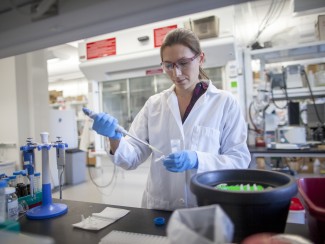
Researching metabolic bottlenecks to increase production of plant-based chemicals
What is the goal of your research?
The goal of my research is to increase the efficiency of the production of isoprenoids. Isoprenoids are a class of molecules. They're made out of these building blocks that are put together in a whole bunch of different ways. And that can have applications in everything from pharmaceuticals to agriculture, to fragrance, and dietary supplements. If we can increase production of these isoprenoids, then we're also increasing efficiency in the production of other really useful chemicals. Through the Great Lakes Bioenergy Research Center, part of my work is helping to get this production scaled up so it can be cost-efficient and resource-efficient; then we'll be able to make all these chemicals using plants and microbes instead of using petroleum.
How do you do that?
I work on the bacterium Zymomonas mobilis, which is one of the key microbes that the GLBRC is developing for the production of isoprenoids. More specifically, I am investigating the steps in isoprenoid metabolism that are currently bottlenecks, or steps where metabolism is the slowest. I am trying to make those steps more efficient so that the overall production of isoprenoids is more efficient, too. I'm doing engineering to identify ways to relieve those bottlenecks, including creating variants of those enzymes or adding additional proteins, specifically proteins that supply the bottleneck enzymes with electrons they need to function. I do a lot of work with deep mutational scan library selections, a method frequently used in enzyme engineering. It involves making a “library” of every mutation possible in a protein, then screening (scanning) that library to see how each mutation affects the protein. In my case, I built a deep mutational scanning library of my bottleneck enzyme and am growing the cells with these mutations to see which mutations survive and which ones drop out, similar to how natural selection works, but done in the lab! And I'm starting to get some work in on Proteus, our new robot.
What is Proteus?
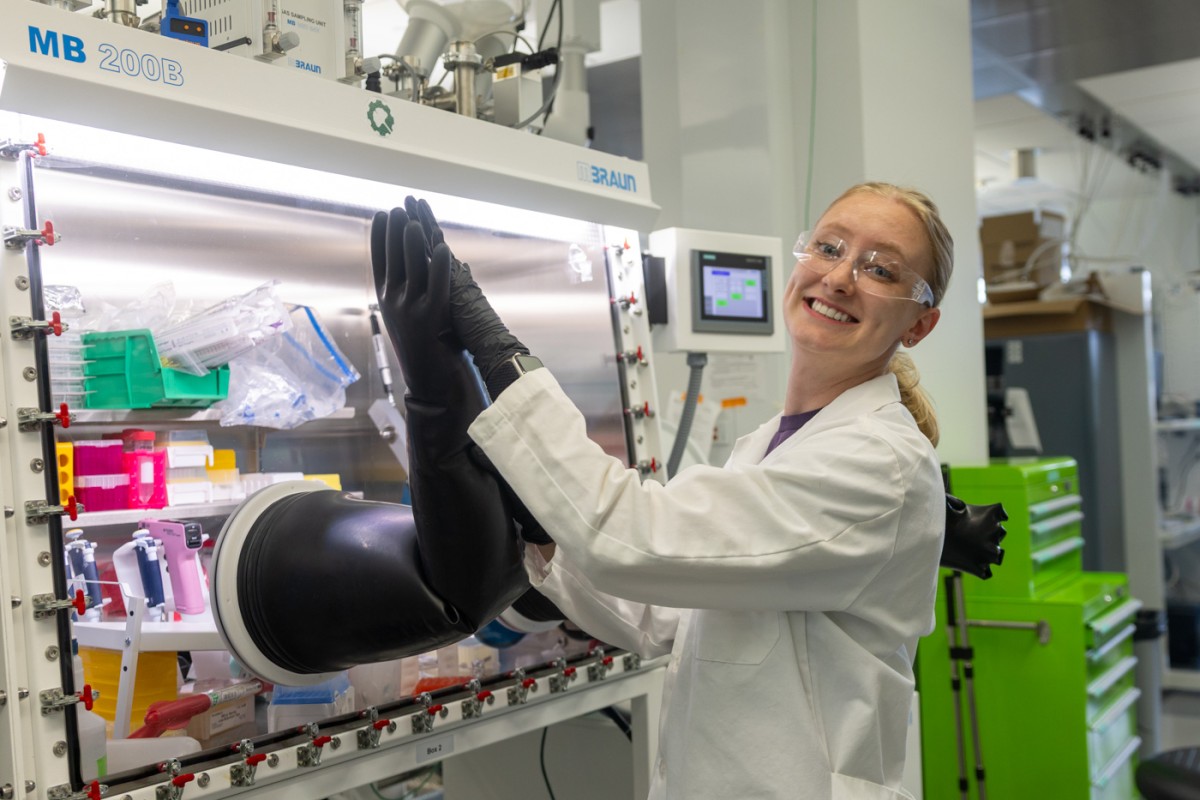
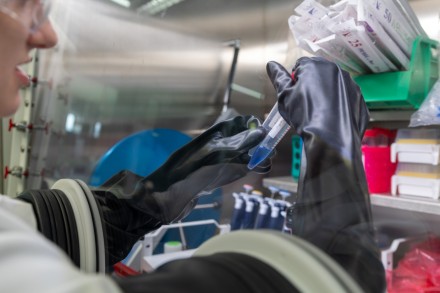
One of the cool things that makes this unique compared to other autonomous labs around the country, around the world, is that it's in a chamber that can go fully anaerobic. It can do a good amount of lab work in the absence of oxygen, which people can't do. It has a liquid handler, so it can do all of your pipetting and mixing for you. There's an incubator, so it can grow cultures at different temperatures and keep them shaking, and it has a plate reader, so it can read different absorbances at different time points. And the whole thing is pretty automated. So you tell it what to do and when to do it, and hit go, and as long as nothing goes wrong, it'll do all of your work for you.
How did you end up researching metabolic bottlenecks?
I was always interested in science and math. I had some really good mentors all the way through middle school and high school, but I wasn't sure exactly what I wanted to do.
I declared a biochemistry major, which let me continue working in biology and chemistry. I took some of those core biochemistry classes in undergrad, and just really loved it. When they threw up the whole map of human metabolism on the board, I was like, Oh my goodness. That's crazy that all that's happening in ourselves. I went straight to graduate school after undergrad, and I haven't looked back.
What obstacles have you had to overcome?
I think the thing that took a lot of intentionality, that I didn't realize at the time, was getting involved with a research program. I loved my undergraduate institution, Nebraska Wesleyan, but it was not a research school. It's a small liberal arts school. We didn't have graduate programs. When I realized that research was something I wanted to be involved with, it took just a lot more intentionality. Sometimes that looked like reaching out to professors to putter around inside labs or emailing labs off campus and saying, “Hey, I don't actually go to your school, but I'd like to work in your lab.”
I think science, and the world in general, works better when people help each other out.
What motivates you?
I love that the work I'm doing could have a real impact on the world. I also love the creative side of it and the puzzle-solving side of it. Finding something that can be both impactful and that I enjoy doing is great.
What is different about your research?
The enzymes that I'm working with have been studied in the past, but so far, the research around those enzymes has been identifying that they are bottlenecks in the metabolic pathway [through which bacteria make isoprenoids], and there hadn't been a ton of work on how to relieve that bottleneck. I started looking at different variants, thousands of variants at once instead of creating individual strains to see which of these enzymes might work better. We knew the enzymes were a problem, but there had not really been work on how to fix that problem yet, and that's where I stepped in to try to work towards fixing the problem.
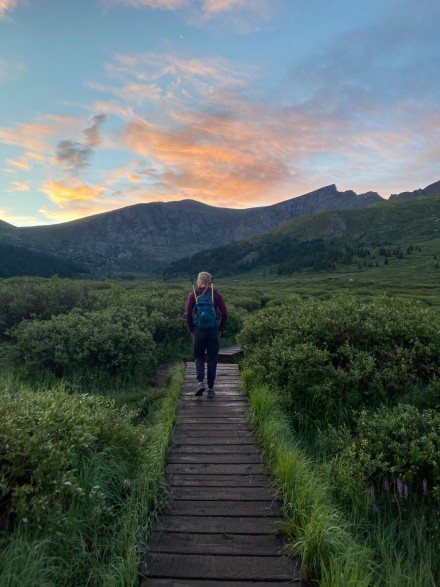
What do you like to do in your free time?
I enjoy a lot of outdoorsy activities, everything from walking and running to going on bike rides and hiking, especially when it's nice out, even when it's not nice out. I also do a lot of crocheting, cross-stitching, and artsy activities. The problem is I almost always give things away,
What advice do you have for future researchers?
Be willing to ask people for help when you need it. People genuinely want to help other people. Email that professor and ask if they have time to meet, or reach out to that other graduate student in your program who works on similar things and say, “I'm having issues with this. Do you want to sit down and troubleshoot?” I think science, and the world in general, works better when people help each other out.