Collaboration between UW–Madison and national lab scientists uses ‘choreographed’ steps to make key ingredient of bioplastics
Lignin, a part of plant cell walls that provides structure, is an abundant, renewable, and domestic source of chemicals that can be used to make plastics such as nylon, which are typically made from petroleum.
But its varied form and tendency to react in unhelpful ways make lignin notoriously hard to break down, limiting its use as a chemical feedstock. As a result, it has often been treated as a waste product burned for heat.
Now a team of national laboratory and university scientists have used a strategy from the petrochemical industry that could nearly triple the yield of key chemicals, potentially making plant-based chemicals more cost-effective and securing a domestic supply chain for manufacturing.
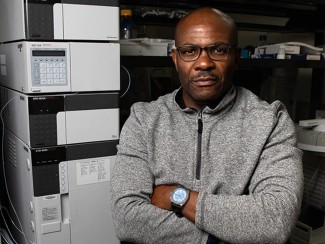
“Lignin has long been recognized as a valuable natural resource, but it presents many challenges in converting it into useful chemicals,” said Shannon Stahl, a professor of chemistry at the University of Wisconsin–Madison and collaborator on the project.

Lignin is a polymer, or chain, of ring-shaped aromatic molecules (monomers) like those found in petroleum. But those monomers are linked with carbon-carbon and carbon-oxygen bonds that make them hard to convert into the individual monomers in a controlled way.
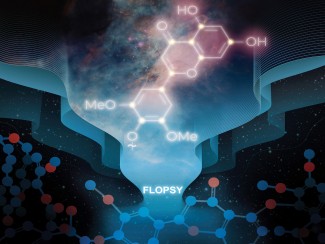
Scientists have developed multiple methods to break down lignin into monomers that some bacteria can convert — or funnel — into target chemicals, but so far these techniques typically generate yields of less than 10% – or 1 gram of product for every 10 grams of lignin.
Researchers from the National Laboratory of the Rockies (NLR), Oak Ridge National Laboratory, and the Massachusetts Institute of Technology worked with Stahl to propose what independent reviewers called “a carefully choreographed sequence” of chemical and biological reactions to get far more product from each gram of lignin. The results were published earlier this month in the journal Nature.
The challenge is that lignin is held together by carbon–oxygen and carbon–carbon bonds, said Gregg Beckham, a senior research fellow at NLR who co-led the study.
“We know how to break the carbon–oxygen bonds, but there aren’t good methods for breaking the carbon–carbon bonds,” Beckham said.
“The real breakthrough was learning how to turn lignin into somethinga material that looks like the materials that industry already works with."
Shannon Stahl
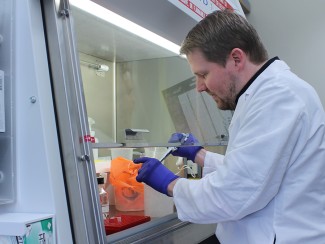
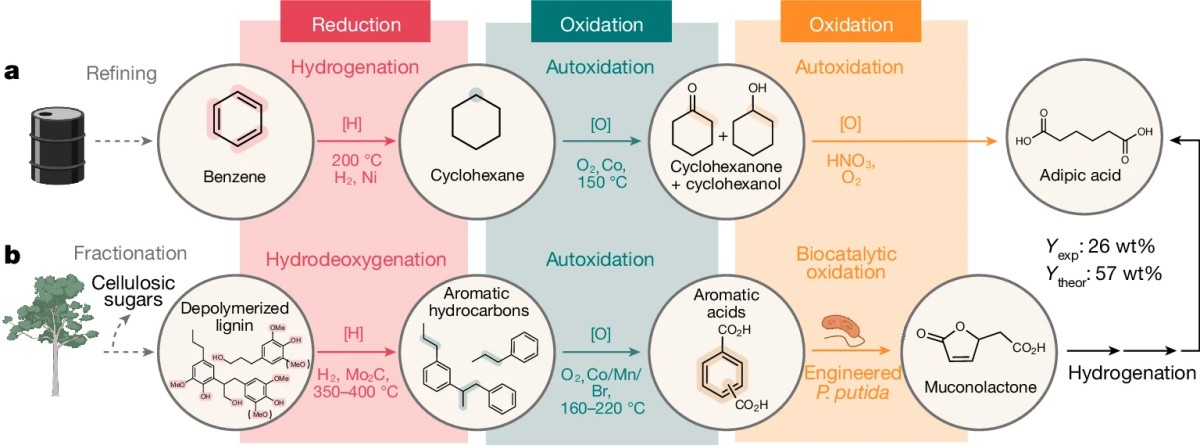
Starting with poplar wood, the researchers used a series of chemical reactions, aided by catalysts that speed up reactions, to break apart and stabilize the lignin into smaller units, removing oxygen groups that would interfere with a later step and then — adapting a process used to make a polyester building block from petroleum — strategically re-inserting oxygen atoms to produce a mixture of water-soluble aromatic acids that the microbes can digest.
Next, researchers at NLR engineered a soil microbe called Pseudomonas putida to convert the aromatic acids into a single product that can be chemically changed to adipic acid, which is used to make nylons.
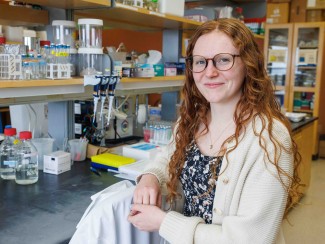
“By engineering three non-native pathways into P. putida, we were able to biochemically converge four aromatic acids to a platform chemical in a single bioreactor,” said Allison Werner, a senior biological scientist at NLR and collaborator on the project.
The lab results produced up to 26% yield of adipic acid from the lignin. With optimization, the researchers say the process could approach yields of up to 57%.
Stahl, an investigator with the Wisconsin Energy Institute and Great Lakes Bioenergy Research Center, says one of the key advantages of this approach is the similarity to conventional chemical engineering methods.
The first two steps generate a mixture of hydrocarbons that closely resemble petrochemicals, which means the material can be converted efficiently into the aromatic acids that are fed to the microbes.
“The real breakthrough was learning how to turn lignin into something that looks like the materials that industry already works with,” Stahl said. “Once this is done, there are many existing processes that can be used to make valuable products.”

In a commentary published alongside the article, Micaela Chacón and Neil Dixon of the Manchester Institute of Biotechnology at the University of Manchester explain how the researchers broke the problem into a series of smaller tasks to produce compounds the bacteria can digest.
“Each step changes the material so that the next step has a lower chemical complexity,” Chacón and Dixon write. “The result is a powerful demonstration of route-level design, in which the success of the process depends as much on how the steps are connected as it does on the performance of the individual operations.”
That choreography is also demanding, they write, noting that each step involves the potential for loss, making the reported yield impressive even while leaving room for improvement.
“This limitation does not undermine the authors’ approach,” they write. “Instead, it points to the next design challenge.”
This research was supported by the U.S. Department of Energy's Alternative Fuels and Feedstock Office in the Office of Critical Minerals and Energy Innovation as well as the Office of Sciences Biological and Environmental Research program.