
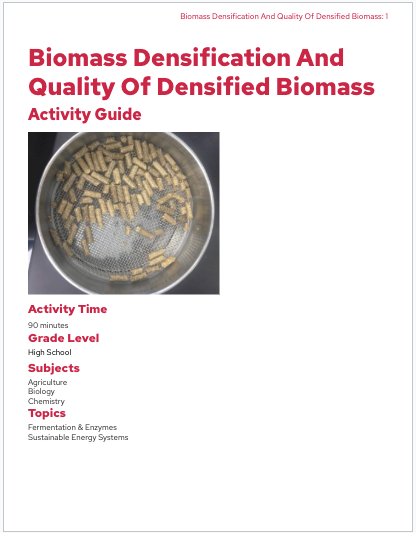
In this lab investigation, students will become familiar with densification, a process used to increase the density of biomass to facilitate its use as a biofuel. Students will then conduct several measurements to evaluate the quality of densified biomass for use as a fuel. Measurements include:
- Bulk density
- Moisture content
- Percent fines
- Length and diameter of biomass pellets
- Durability
Learning Objectives
Upon completion, students will be able to:
- Define terminology associated with biomass densification and quality of densified biomass
- Conduct procedures for evaluating the physical quality of densified biomass used for fuel. Measurements include bulk density, moisture content, percent fines, length and diameter of biomass pellets, and durability
- Apply concepts of densification and quality control to bioenergy system management
Concepts/Skills
Densification, Energy Content, Biomass Processing
Prior Knowledge
Background provided
Time Required
90 minutes
Required Supplies
1.5-2 cubic feet of densified biomass (wood or other biomass pellets), 1L beaker, ruler/straight-edge, drying oven, glass/metal/ceramic containers capable of holding at least 50 cubic centimeters, dessicator, 1/8 inch opening or U.S. Standard no. 6 screen sieve, receiving pan, Vernier Caliper capable of measuring diameter and length to within 0.001 inches, quart-sized resealable poly storage bags, scale capable of weighing up to 2-3kg to the nearest 0.1g, analytical balance