
Artificial Intelligence is changing the world in ways both promising and concerning. UW–Madison has launched both the RISE-AI Initiative and the new College of Computing & Artificial Intelligence to explore how this technology can be designed, developed, and used for the public good. Many researchers are already using AI tools to unlock new capabilities in their research, accelerating discoveries and gaining new insights from massive data sets. This forum will explore how AI can enhance energy research and how academic uses may differ from personal and commercial applications.
Join the Wisconsin Energy Institute on September 29 at 4:30 CT as expert energy researchers from across UW-Madison discuss how these tools are transforming their science.
This Forum is hosted in collaboration with the RISE-AI Collaboration HQ.
The University of Wisconsin-Madison is a barrier free campus and is committed to providing equal opportunity for participation in all programs, services, and activities. If you need an accommodation for this event please let us know by emailing outreach@energy.wisc.edu or calling 608-890-0946. Requests made with less than 3 weeks’ notice will be honored when possible.
Moderator
Kyle Cranmer, Physics Professor, David R. Anderson Director of the UW–Madison Data Science Institute, UW–Madison
Kyle Cranmer is professor of physics, director of the Data Science Institute at UW–Madison and lead of the UW RISE-AI program. He has been honored with the inaugural Pritzker Prize in AI for Science for his role in establishing a powerful new approach to data analysis that leverages advances in machine learning and artificial intelligence. Prior to starting his work at the DSI in July 2022, Cranmer was a professor of physics at New York University for 15 years and the executive director of the Moore-Sloan Data Science Environment, where he worked to understand the institutional changes necessary to establish data science in academia. He is an alumnus of the UW-Madison Department of Physics; after earning his Ph.D. here, he was a fellow at Brookhaven National Lab. He was awarded the Presidential Early Career Award for Science and Engineering in 2007 and the National Science Foundation’s Career Award in 2009. Cranmer was elected as a fellow of the American Physical Society in 2021, and he was selected as Editor in Chief of the journal Machine Learning: Science and Technology in 2022. He grew up in Arkansas and was in the first graduating class of a public, residential high school for math, science, and the arts.
Panelists
Michael Botts, High-throughput BioDesign Facility Leader, Great Lakes Bioenergy Research Center, UW–Madison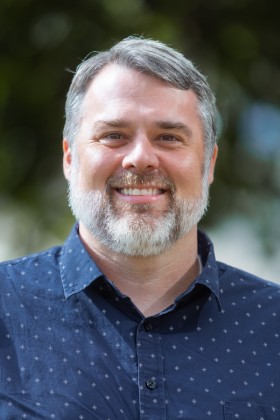
Michael Botts collaborates with WEI and Great Lakes Bioenergy Research Center (GLBRC) investigators to use automation tools to accelerate the engineering of microbes that improve the profitable conversion of sustainable feedstocks to bioproducts. This work includes designing and validating automated workflows using robotics to carry out novel genetic selection and screening experiments.
In addition to his work with lab automation, Michael oversees operations of the GLBRC metabolomics core facility, which is responsible for performing analytical chemistry assays to measure the conversion of feedstocks to bioproducts. This work includes supporting lab staff in developing and validating new assays to quantify metabolites or bioproducts of interest and maintaining performance of assays that support a large number of GLBRC research projects and investigators. Botts received his Ph.D in Biomolecular Chemistry from UW-Madison and his B.S. from the University of Florida.
Dane Morgan, Harvey D. Spangler Professor of Engineering, Materials Science & Engineering UW–Madison
Dane Morgan is the Harvey D. Spangler Professor of Engineering in the department of Materials Science and Engineering at the University of Wisconsin, Madison. His work combines thermostatistics, thermokinetics, and informatics analysis with atomic scale calculations to understand and predict materials properties. Morgan is presently training or has graduated/trained over 70 graduate students and postdoctoral researchers, and he founded and co-leads the Informatics Skunkworks, which has helped engage over 600 undergraduates at the interface of data science and science and engineering. He has received multiple teaching and research awards and has published over 400 papers in materials science.
Paul Wilson, Grainger Professor of Nuclear Engineering, Nuclear Engineering and Engineering Physics, UW-Madison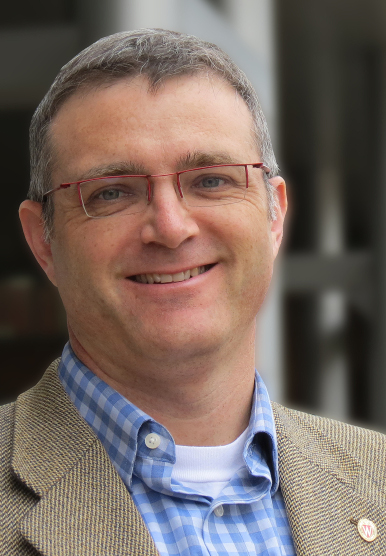
Paul Wilson is the Grainger Professor of Nuclear Engineering in the UW-Madison Department of Nuclear Engineering and Engineering Physics. His research interests focus on developing improved tools for computational modeling of complex nuclear energy systems, with applications in radiation shielding, nuclear waste management, nuclear non-proliferation and energy policy. Paul joined the University of Wisconsin-Madison as an assistant professor in August 2001 as part of the Energy Systems and Policy Hiring Initiative.
In addition to the research pursued by his Computational Nuclear Engineering Research Group (CNERG), Paul has served in a number of advisory and consultant roles. From 2001-2003, he was a member of the U.S. Department of Energy’s Generation IV Technology Roadmap Committee. In 2010, he was engaged as a consultant to the CEA Saclay, ERC Petten, the Karlsruhe Institute of Technology, and the Blue Ribbon Commission on America’s Nuclear Energy Future.